


Pediatric Specialty Care in Erie


Specialty Care Provided at Erie


We Understand the Unique Medical Needs of Children


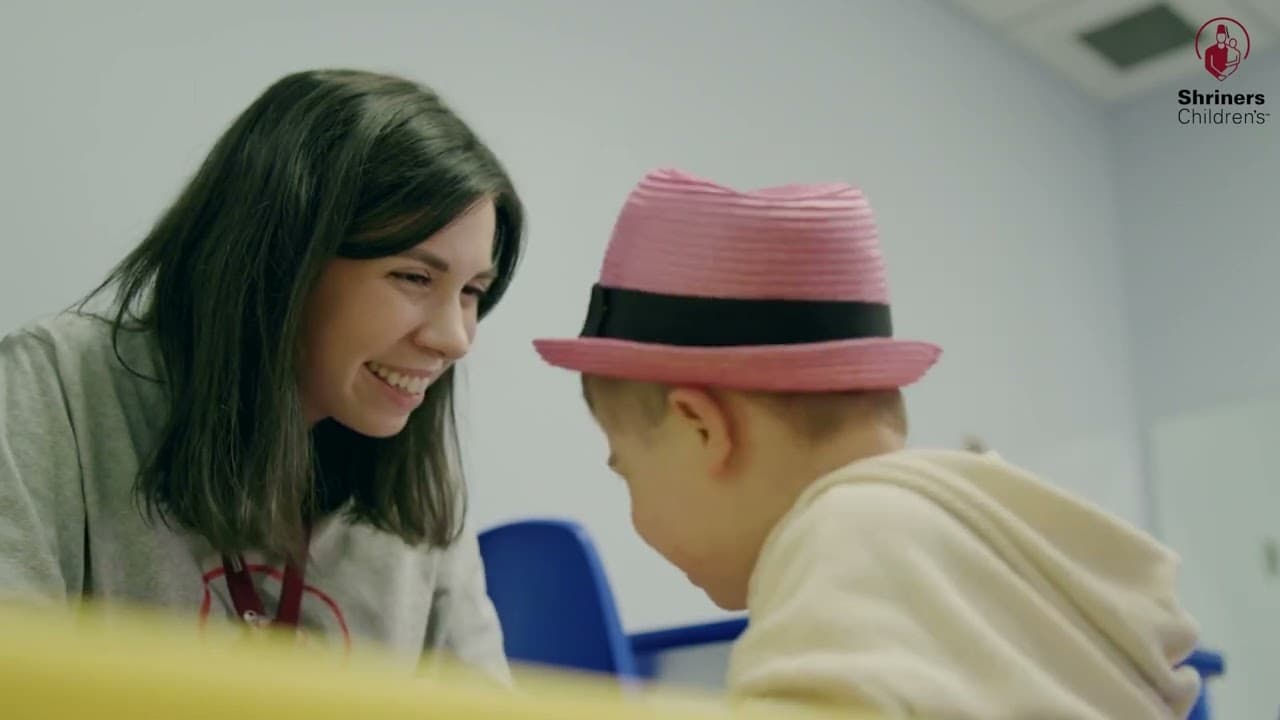
Shriners Children's Erie 2024
[Shriners Children's logo]
Mary Eighmy, PT, DPT, OCS, Physician Liaison:
At Shriners Children's Erie we have the privilege of offering a variety of services for children age birth to 21. Our services include but are not limited to pediatric orthopedic surgery, physical medicine and rehab, prosthetists and orthotists, physical therapy, occupational therapy.
Christine Betancourt, PA-C, MPAS, Physician Assistant:
I think in the world of orthopedics, you can have a similar injury as a child and as an adult and you can have a completely different injury, so it's important for the patient to have someone that is very well versed and has seen these types of injuries in kids. We know how to manage them appropriately so that we're not undertreating, but we're also not over treating these kids. And I think that's really important.
Alex Betancourt, CPO, Manager, Pediatric and Orthotic Prosthetic Services (POPS):
So POPS is the pediatric orthotics and prosthetic services. It is the orthotic and prosthetic arm of Shriner's Children's. Orthoses are more commonly known as braces, but they are external devices that are used to either correct or support a weakened or deformed limb that a child would need to be functional. Prosthesis is a little bit more, I suppose, well known. It's an artificial limb, arms or legs primarily. And we treat everything from head to toe. We have a great team down in Tampa who serve our staff and our patients extremely well. It's been nice for us to have that in house feel.
Mary Eighmy:
We have the privilege of working with a multidisciplinary team. And so what that multidisciplinary team approach really means is that a child and a family may be able to see multiple practitioners, potentially all in the same day, which cuts back on multiple appointments for that family and also enhances communication between providers.
Alex Betancourt:
The first thing that we work with with the families is what are their goals, and everything is stemmed from that. It really starts with the patient. That's where we also tie in the multidisciplinary team, because if we see that there's something that we think from a rehab side needs to be addressed, we have them right around the corner just to go ask, pull them into a room and get a consult.
Christine Betancourt:
My goal as a provider is to provide the best possible care that I can, and my job is made significantly easier when I'm here and supported by people that have the same vision in mind. And we don't have to think about if the insurance plan is going to cover X, Y, Z. Each patient gets the same treatment no matter their means. I think as a parent that's what I would want for my child, and I'm happy to be able to provide that with the facility here.
[Shriners Children's logo]
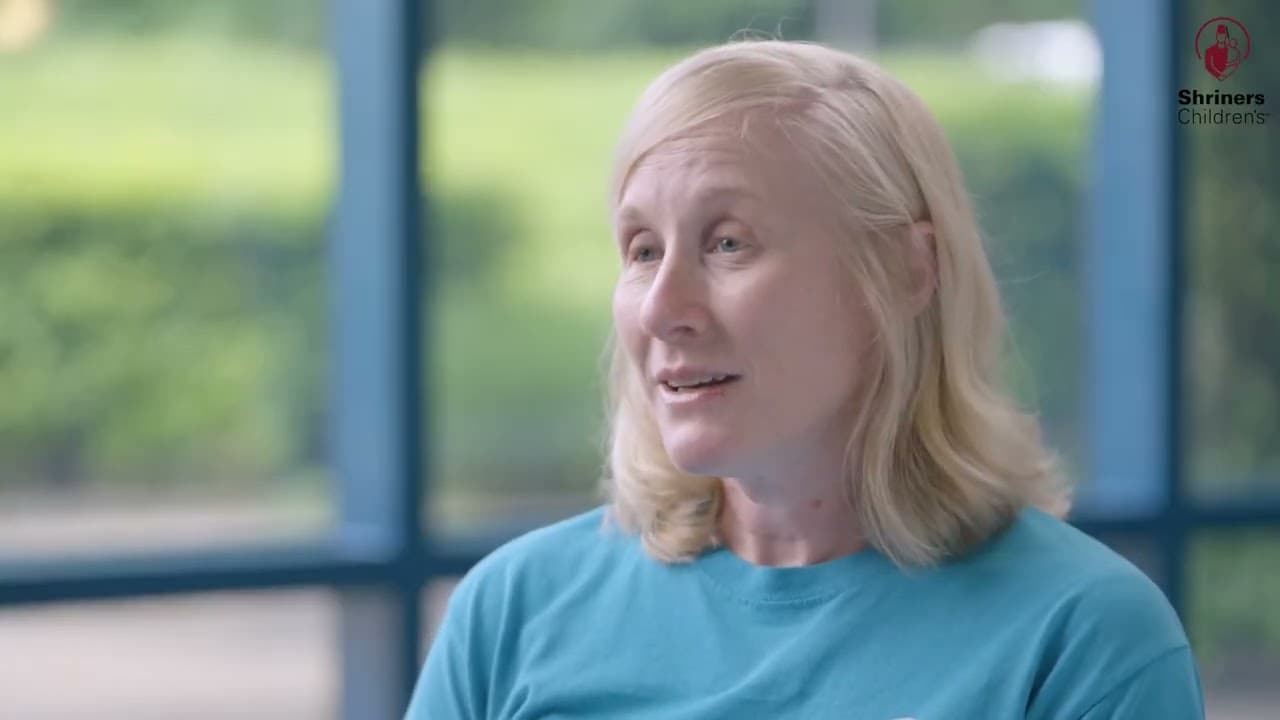
Play at Shriners Children's Erie
[Shriners Children's logo]
Rebecca Bowman, PT, DPT, Manager of Rehabilitation Services:
At Shriners Children's Erie, we're able to offer an environment that is fun. It's colorful. It doesn't appear as a standard medical office. So here, walking into the building, kids easily find their way. They're looking for the next toy they want to play with. They're looking for the friendly face, the smiles of the staff. And then walking back into the therapy space, we have the toys, the equipment. We also have a therapeutic playground on our property, which is very unique. And so for a child to come here and feel like they're playing, they don't realize how hard they're actually working and how difficult and challenging the activities really are. And that's what helps them achieve their goals.
Michelle DeRooy, CCLS, Child Life Specialist:
I run the sled hockey program. It is a fantastic program, because if you don't know what sled hockey is, the kids are able to play hockey, they get in a sled, a special sled that they can sit on. And they have specialized sticks that one end is a pick and they can propel themselves, and then they can turn them around and hit the pucks with it and everything. We do have another program. It's the wheelchair basketball program that is ran during the summer. In the backside of the building, there's a basketball court, and the kids sit on sports wheelchairs and they get two hoops set up. And in the past they've brought in local teams. And, again, the kids get to play basketball and it's really fun to watch them because they get really into it and everything. It's really cool because you have kids that want to be able to do sports, but they may not be able to. And just to see the joy, it just gives them the freedom that they've not been able to do it. And it's so awesome to see that kids can do anything.
Micheal Widrig, Marketing & Communications Manager:
Children are not small adults. They require specialized care. We provide that pediatric focused care here in Erie, and our providers understand the special needs of children, which are different than adults. And so that's the main reason I would never take my children anywhere else for care.
Michelle DeRooy:
Play is so important because it's such an important part of a child's life. It's natural to them. It's what they know. And so they're coming to a very unfamiliar situation, very uncomfortable situation, but they know play. And so if I bring in toys, they're going to be like, "Oh, I just get to play." And that's what we want them to do. And it's amazing even watching them play with the toys, the doctors can see what they need to see, watch how their hands move, or I'll be like, "Hey, come get this toy," and they'll walk right to me because it's something fun and it allows the doctor to see what they need to see too.
[End card - Shriners Children's logo]
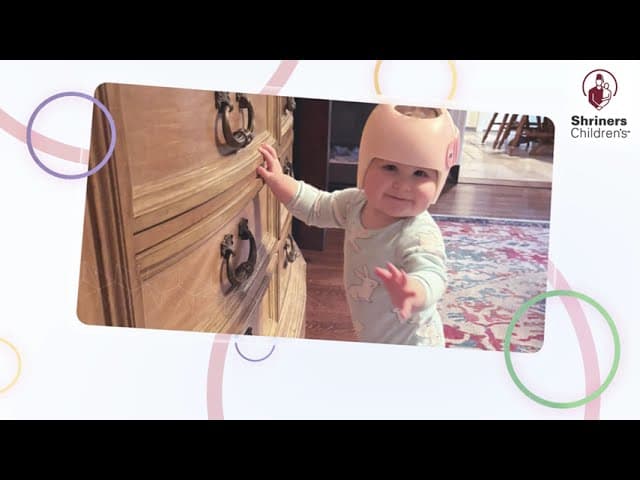
Serafina's Experience with Cranial Remolding
[title card: Serafina's Story]
[Shriners Children's logo]
Speaker:
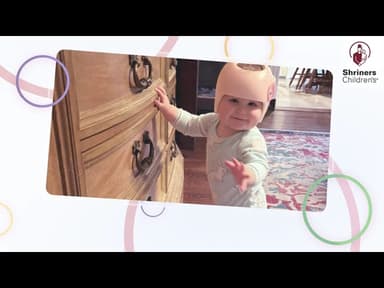
I was at a regular, well baby checkup and the pediatrician noticed that my daughter was not turning her head properly to one side. The other side was fine and it was suspected at birth because she was frank breach in utero. And so her head was stepped one side. At seven months, they realized that her head really was not turning well the one way. So we got referred to Shriners and got right in for an appointment during which everything was able to happen at one time. So we saw the nurse practitioner, she did measurements, she evaluated, then we immediately got to see the physical therapist and she recommended that we go to POPS to get a um, more thorough evaluation of the shape of the head. The nurse practitioners diagnosed her with both plagiocephaly, the flat head caused by the torticollis, the inability to shift her neck in both directions.
And I had never heard either of those terms for my own children or in general. And I was intimidated by them. And I felt terrible that my child was going through something that we didn't realize, you know, was a diagnosis, let alone one that she had. So I had a lot of questions that they answered so thoroughly and so kindly, and I was so glad that the moment that we heard those diagnoses, there was also a plan set in place the same day. So it wasn't diagnosis, panic, panic, and then wait to get in to see someone to have a plan of action. Everything was able to happen in the one appointment since there, or all the practitioners under one roof.
When the POPS team did the 3D model of my daughter's head, I was shocked 'cause it looks different in person. You know, you're looking at the head that you see every single day, but whenever they show the deficit or the flat spot, it's really shocking. And I was so grateful 'cause they gave a really accurate measurement. When I saw it on the screen. I knew immediately that I would go through with whatever intervention POPS recommended. Um, whereas before I was sort of on the fence if she would need the helmet or not.
My initial reaction, I thought that it would be painful for her and also complicated for us as parents to, um, navigate. But I did not yet understand how it worked. And Hannah, in the pops department explained how it works, how it's not painful for the baby and it allows the baby's head to grow properly rather than molding it like clay. Like it doesn't actually hurt them at all. And then once it was on Seraphina, it was, she had no idea, she didn't even care. They're so young and they're the age where they're just starting to explore their environment. They don't have any clue that there's something very lightweight and very easy to put on on their head. And the care of it was very simple. You just take it off whenever they're about to go into the bath, clean it with rubbing alcohol and let it air dry.
I would tell a parent who's facing a similar situation with their child to ask all the questions to trust Shriners because every question I had, if it did not belong to the department I was asking it of, they would forward that question on to someone else and give it right back to me. So no one ever said, I don't know. No one ever said, that's not my department. They would find the answer for me, give it back, um, or match me with a practitioner that would be able to answer the question.
Oh my goodness. When she graduated from the helmet, I cried. I was so excited. They gave her a certificate with her name and the date of her graduation and everybody was congratulatory. She did so well with the helmet and I'm just so grateful to the professionals that worked with us. But they got us in and out in four months.
[Shriners Children's logo]
What's Happening at Shriners Children's Erie


Help Us Provide the Gift of Hope and Healing

Keep In Touch
Join our mailing list to stay up to date on everything that's happening at Shriners Children's.