


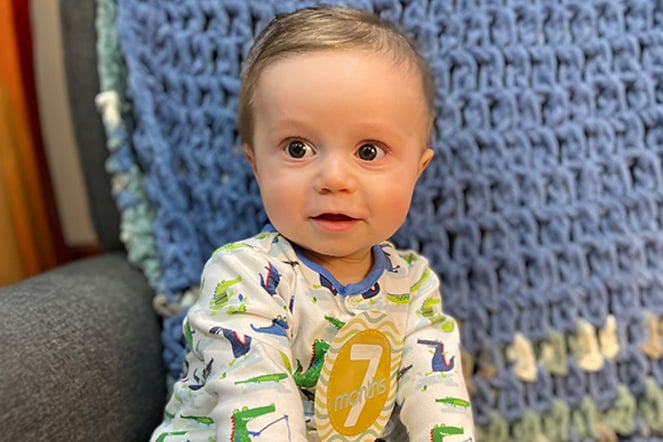
Casey celebrates turning 7 months old.
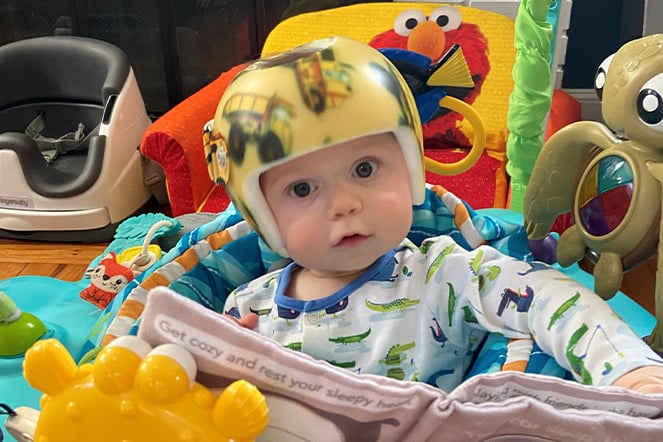
Casey plays in his exersaucer after receiving his custom helmet.
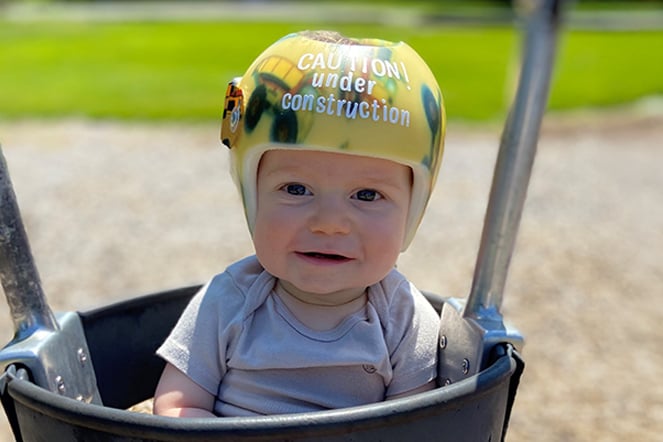
Casey enjoys the playground on a warm summer day.
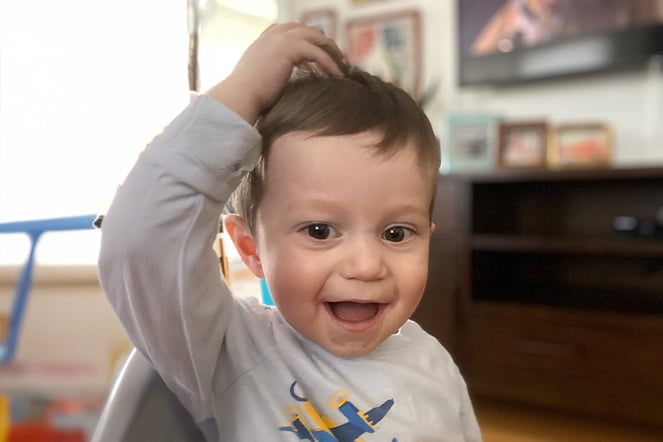
Casey is excited at the conclusion of his cranial remolding treatment.

Amanda began researching information about infant head shape abnormalities and continued to advocate for Casey to be evaluated by a craniofacial specialist.
At Casey’s six-month check-up, the pediatrician made a referral for cranial remolding care at Shriners Children’s New England. There, Amanda found a supportive team of specialists ready to answer all her questions and guide her through every step of Casey’s treatment.
Amanda knew she was in the right place at Casey’s first visit with Jonathan Lee, M.D., MPH, director of cleft and craniofacial surgery at Shriners Children’s New England. Dr. Lee diagnosed Casey with plagiocephaly, a condition in which a baby’s head is misshapen or develops a flat spot. “It turns out Casey was actually on the moderate to severe part of the scale,” Amanda said. “I was so glad we were proactive.”
Plagiocephaly can be caused by factors such as limited space in the womb, birth trauma or prolonged positioning. Dr. Lee confirmed Casey was an ideal candidate for cranial remolding therapy, also known as helmet therapy, to guide his natural skull growth and gently correct his head shape. “Casey’s journey highlights how important early referral to a craniofacial specialist can be in cases of plagiocephaly,” said Dr. Lee. “Our multidisciplinary team can tailor a comprehensive care plan that is specific to the child and provide the necessary education and resources for the family.”
Next, Amanda and Casey saw Liz Selgrade, MSPO, CPO, a prosthetist-orthotist in the Pediatric Orthotic and Prosthetic Services (POPS) department. Liz completed an initial scan of Casey’s head that was then used to create a customized orthosis.
The team at Shriners Children’s New England instantly put Amanda at ease as they outlined Casey’s personalized care plan. Amanda notes that nurse Nicole Pappas, BSN, RN, the cleft and craniofacial program coordinator, was a constant source of support. “Nicole made me so comfortable right off the bat. I had question after question, and she was committed to finding the answers. If I left the building and had questions, she was always there to help when I called.”
Do your research and ask questions, no matter how silly they sound, and remember that you’re not alone. Someone at Shriners Children’s New England is always there with answers for you.
When Casey was fitted with his helmet, he was nearly 7 months old and settled into established routines with feeding and sleeping. Amanda was concerned they might both have a hard time adjusting to the helmet. “Since I was still nursing, I wondered how comfortable we would be together,” she said. “Liz was so patient and gave me pointers to help Casey adjust to the helmet and find a nursing routine that worked. “
The goal is for babies to wear their helmets 23 hours a day to see optimal results. Families reach this threshold gradually over several days, starting with an hour on, then an hour off, and building from there. Despite a few early obstacles, Casey acclimated well. “The first time he was supposed to wear the helmet straight through the night, he just couldn’t fall asleep,” said Amanda. “After we got over that hurdle, Casey was wearing it throughout the day and night with no issues.”
For the next five months, Casey and Amanda returned to Shriners Children’s New England every two weeks. Liz took a new scan of Casey’s head every six weeks, and Dr. Lee assessed his overall progress. Amanda was encouraged by the results of Casey’s first follow-up scan. “He went through a major growth spurt,” she explained. “Not only did his head grow, but we also saw significant improvement in his head shape.”
As the weather got warmer, Liz modified Casey’s helmet to improve ventilation. She also showed Amanda how to clean it when needed. “Casey’s family was a joy to work with,” said Liz. “He had such success with the treatment because they stuck with it, day after day, for five months. I always tell families that helmet treatment is harder for the parents than the baby, since it requires more work for already busy parents. But the results are worth it.”
According to Amanda, Casey’s treatment just became part of their routine. “The helmet really didn’t faze Casey. Even on extremely hot days, he was crawling and playing with it on. He thought it was part of him, and it was our new normal.”
The welcoming environment at Shriners Children’s New England made their visits enjoyable. It was an opportunity for Amanda to get out of the house with Casey and his older brother, Leo, on nice summer days. “It was an adventure for Leo, even though the appointments weren’t for him,” said Amanda. “He got praised for being a good big brother, and someone always gave him toys to play with, which also made his day.”
Casey’s successful cranial remolding treatment concluded just after his first birthday. Reflecting on the experience, Amanda has helpful advice for other families beginning a similar care journey. “We see such a difference in his head shape, and we’re so glad we did it,” she said. “Be vigilant – not all doctors see what you see. Do your research and ask questions, no matter how silly they sound, and remember that you’re not alone. Someone at Shriners Children’s New England is always there with answers for you.”


