


The Transformative Power of Laser Treatment for Scars
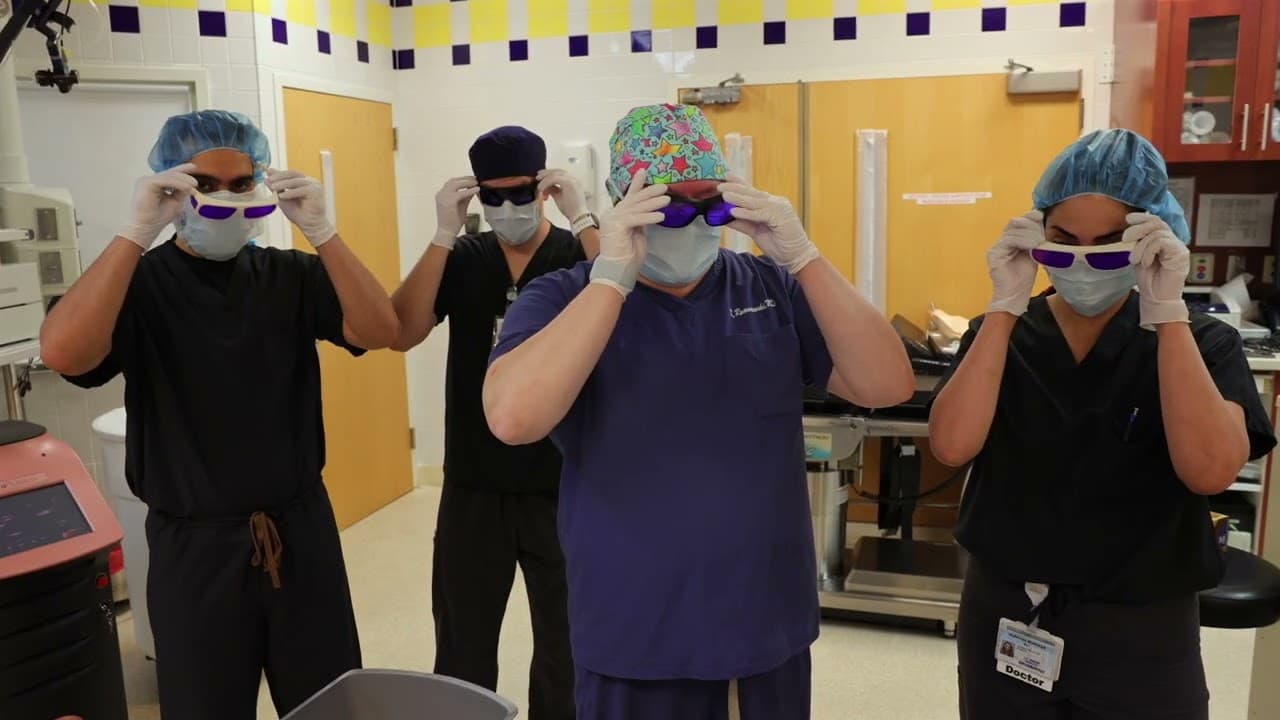
The world-renowned burn teams at Shriners Children’s are increasing and expanding the use of transformative technology to bring relief and comfort to young burn survivors.
Physicians Kathleen Romanowski, M.D., Branko Bojovic, M.D., Sara Higginson, M.D., and Ramon Zapata-Sirvent, M.D., are leading the healthcare system’s enhanced use of lasers as an innovative and effective tool for advancing the treatment of scars caused by burns and other accidents and events.
Focused Effect
The letters in the word laser stand for Light Amplification by Stimulated Emission of Radiation. Because laser light stays focused and does not spread out, lasers can concentrate a lot of energy on a very small area. Lasers are used in precision tools, which is why they’re used to cut through diamonds or thick metal. Lasers also have revolutionized many aspects of medical treatment since their development several decades ago.
“It's established through the American Burn Association that to be a burn center, laser is a standard of care,” said Dr. Higginson, chief of staff at Shriners Children’s Ohio. “Often, laser treatment is viewed as cosmetic, but the way we apply it is a much more aggressive application of the laser. It burns deeper and actually removes some scar. It's a way to do a non-surgical release of scar tissue.”
“Our CO2, or a carbon dioxide laser, treats scar thickness. It bores tiny little holes in the burn scars, creating a new wound, which allows the scar's collagen to rearrange, and that flattens the scar,” said Dr. Romanowski, a burn surgeon at Shriners Children's Northern California. “The other thing these tiny little holes allow us to do is drug delivery,” Dr. Romanowski said. “With the laser treatment, we can deeply apply a steroid to help decrease inflammation of the wound and decrease itching.”
Dr. Romanowski noted an added benefit is that laser surgery also helps reduce the appearance and impact of scarring.
“My patients tell me the things they really care about is that laser treatment helps them move better and itch a lot less, while the parents always say the scars look a lot better and their kids feel a lot better, and are more confident about their appearance,” Dr. Romanowski said.
Dr. Higginson agreed, adding that the impact is dramatic. She shared a story of David, a young man from Ukraine, who could not even get a full night’s sleep.
“After one laser treatment, the itching was so diminished that he slept through the night for the first time,” Dr. Higginson said. “It decreases a lot of the intense sensation and itching that they're having with the scars. If you can get them a full night's sleep, then they can go to school and do well. It just changes their entire life.”
Dr. Ramon Zapata-Sirvent, a plastic and reconstructive surgeon at Shriners Children’s Texas in Galveston, also uses an ultrapulsed CO2 laser to improve the appearance and flexibility of scars. The laser creates thousands of thin deep holes inside the burn scar, breaking the disorganized, thick collagen fibers that create the scar and the contracture.

The burn team at Shriners Children’s Northern California performs laser treatment on a patient.
Skin Grafts, Contractual Releases and Lasers
For children who have traumatic burns, many must have skin grafts to heal the wounds. For a skin graft, healthy skin – this can be a split-thickness graft (epidermis and part of the dermis) or a full-thickness graft (epidermis and entire dermis) – is harvested from a less visible part of the body and is carefully placed over the burn wound and secured, often with stitches or staples. The area is then bandaged to protect it during healing.
Unlike normal skin, which grows and stretches with the child, grafted skin lacks the ability to grow at the same rate. As the child grows, the surrounding skin expands, but the grafted area remains relatively fixed in size, looking different than surrounding skin, and becoming tight and limiting movement. This is called a contracture.
To mitigate these conditions, burn surgeons perform a contractual release procedure. This surgery can include techniques to lengthen the scar tissue by creating zigzag incisions that allow the skin to move more freely. It can also include new skin grafts to cover the released area. One of the most promising aspects for advanced laser treatment is the opportunity to reduce the number of contractual release procedures a patient will need.
“What the laser allows us to do is give this child ongoing therapy to prevent the development of contractures, hypertrophic and thick, bulky scars, and maintain function without doing major surgeries,” Higginson said. “So, a pediatric patient who is burned when they're very young may have 20 surgeries before they've stopped growing. You can cut that number dramatically with the application of fractional CO2 laser and laser-assisted drug delivery to the scars.”
Branko Bojovic, M.D., chief of plastic, reconstructive and laser surgery at Shriners Children’s Boston, explained that the advanced laser treatment options available at Shriners Children’s can be applied to more than just burn scars. Patients with scarring from lacerations or a traumatic injury, such as a dog bite, can benefit from laser treatments. Certain congenital conditions, such as congenital nevi, can also be improved with this approach. Congenital nevi are pigmented birthmarks (moles) that appear at birth and can expand in size over time.
“After burns, injuries from laceration and dog bites are the most common scarring that we see. The methods used to improve scars from congenital conditions, like nevi, as well as scars from lacerations and other traumatic events not related to burns, are based on the work done in the field of burn care. Shriners Children’s is well-positioned to offer a full spectrum approach to scar management,” Dr. Bojovic said.
Dr. Bojovic noted, “Our laser therapeutic options for burn and traumatic scars are cutting-edge, and our approach is unique because it is surgeons, collaborating with dermatologists, offering these treatments as a continuous therapy option. We are uniquely poised to offer long-term scar management using laser treatment throughout a patient’s childhood. This long-term care enables the best outcomes for patients in terms of their appearance, mobility and function after injury.”

Dr. Bojovic with a patient.
Advancing the Field
Shriners Children’s is pursuing strategies for increasing the use of lasers to delay the need for contractual release procedures, and her work is having good outcomes.
“We want to develop best practices that include getting burn patients into pressure garments that promote healing and reduce scarring, tracking patient recovery, and using laser treatments to get better skin pliability and range of motion,” Dr. Romanowski said. “We are having success and have been able to delay contractual releases for some patients by more than a year.”
This is particularly important for patients and families. Contractual release procedures are operations that can require up to 10 days of recovery in the hospital. Meanwhile, CO2 laser treatments, while also performed under anesthesia, generally take less than an hour and are outpatient procedures that allow patients to go home the same day.
Shriners Children’s, with Dr. Romanowski and Dr. Higginson leading the way, has launched a research project that will make it easier for all children suffering from burn injuries to receive laser therapy.
“Our goal for the study is to show that laser treatment is not cosmetic. This is a necessary application in a population that would require a lot more aggressive treatments were the laser not available,” Higginson said. “We are going to take objective measurements, and we are going to show the evolution of the scar through laser treatments. This will allow Shriners Children’s to support other burn centers in getting laser treatments covered for kids.”
Children who have received initial care from other providers are welcome to seek follow-up care, like CO2 laser treatment, at Shriners Children’s.

Dr. Higginson speaks to the public.


The Transformative Power of Laser Treatment
Keep In Touch
Join our mailing list to stay up to date on everything that's happening at Shriners Children's.
Next Steps
Share Your Story

Give to Shriners Children's

