


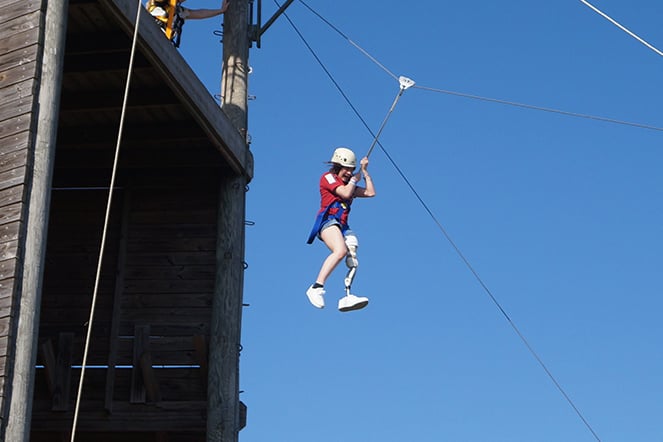
Kely tries out the zipline at Camp Love Without Limits.
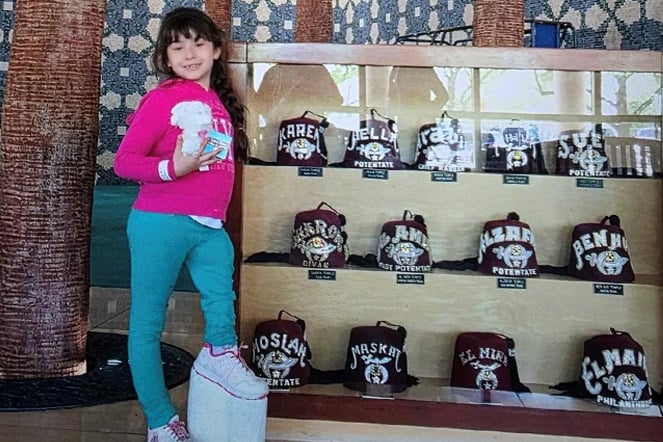
Kely stands next to a display of Shriners' fezzes.
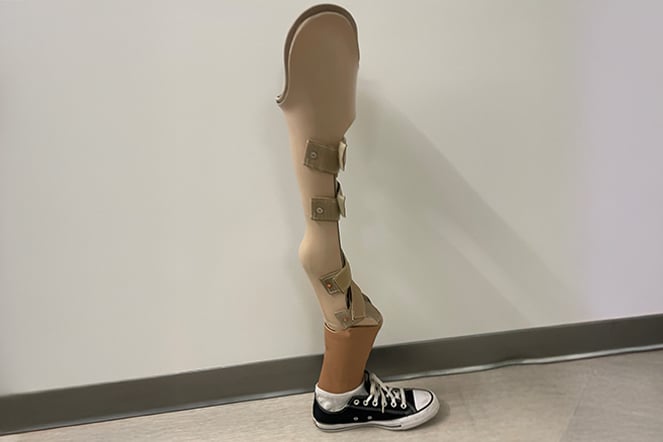
Kely's prosthesis that she wore prior to her amputation is pictured.
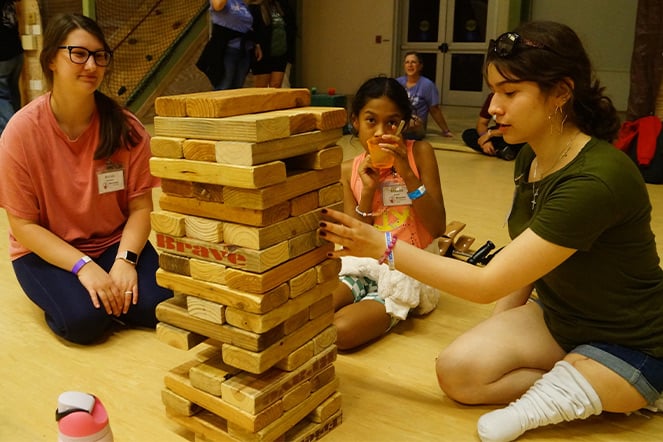
Kely plays Jenga at Camp Love Without Limits.

Meet Kely.
“You never know what someone else is feeling, so I just try to be kind.”
And kind is exactly how those around Kely describe her. Encouraging, friendly and full of joy, Kely is a typical 10th-grader in many ways. She loves singing along to Doja Cat, spending time with friends, eating tacos al pastor and watching movies like The Princess Diaries and Clueless. She adores her two dogs and especially enjoys science class at school. But unlike most teenagers, Kely has spent much of her life navigating complex orthopedic care.
She was born with proximal femoral focal deficiency (PFFD), a congenital condition that affects the development of the femur and hip. “My femur was smaller, I only had the tibia, and my foot pointed downward, like a Barbie foot,” Kely said.
As a young child, frequent falls were common. Still, they never stopped her from trying new things like riding a bike or roller skating.
“Honestly, I always did whatever I wanted, even though I would fall all the time,” she said.
When she was 7, Kely began specialized orthopedic treatment with Shriners Children’s Texas. She received an extension prosthesis commonly used for patients with PFFD, and began physical therapy. As part of her care, she also worked with the behavioral health team, including psychologist Laura Rosenberg, Ph.D., who helped Kely navigate the emotional challenges that came with her condition, especially conversations surrounding amputation.
“I always knew I was different, and I wouldn’t care,” Kely said. “But then when I was like 10 or 12, I started to care.”
As she entered her teenage years, Kely found herself wanting a prosthesis that offered more flexibility and mobility. She wanted to sit comfortably in a car or on a bus without removing her prosthesis and hoped for a limb that felt like a true part of her body. Through her care at Shriners Children’s Texas, she had the opportunity to meet another patient who was also born with PFFD. Seeing what was possible helped Kely envision a new future for herself. After thoughtful consideration, she made the brave decision to undergo amputation of her left foot in May 2025.
“This was a process,” Kely said. “I needed time to understand myself and accept myself. I wouldn’t have made this decision when I was younger. But I knew I was in the best hands with Dr. Sanderson. He is brilliant, and I admire him so much.”
Everyone at Shriners Children’s Texas has such a big heart.
Cody Sanderson, M.D., Kely’s pediatric orthopedic surgeon, performed her amputation and describes her as the “definition of grit.” Her certified prosthetist, Anna Brown, C/LPO, said Kely’s positivity is evident throughout the hospital. She is often seen encouraging other patients and families.
“Following her amputation, Kely essentially had to relearn how to walk since she had never used a prosthesis with a knee,” Anna said. “With several visits to POPS [Pediatric Orthotic and Prosthetic Services] for fine-tuning and lots of hard work in physical therapy, she made quick progress. She went from using a walker to crutches to walking independently.”
This spring, just weeks before she was scheduled to receive her new prosthesis, Kely experienced an unexpected setback. While walking with friends during a busy school passing period, she slipped on a banana peel and fell.
“I was crying, laughing – everything at the same time,” Kely said. “A banana peel, for real?”
The fall resulted in a fracture near her hip that required surgery. Dr. Sanderson successfully repaired the injury, and Kely is expected to make a full recovery.
“This was just a bump in the road, but nothing Kely can’t recover from,” Dr. Sanderson said.
While she completes a few more weeks of non-weight-bearing rest before continuing her prosthetic fitting, Kely is focused on moving forward. “I feel so proud of myself, and I am so thankful for the people here,” she said. “Everyone at Shriners Children’s Texas has such a big heart.”
As she looks ahead, Kely is excited to write her own music, return to Camp Love Without Limits and visit the beach. Fluent in both English and Spanish, she hopes to connect with other patients considering amputation and offer encouragement from her experience.
“Kely always has a smile on her face,” Anna said. “When I think of a Shriners Children’s success story, I genuinely think of her.”

Kely stands next to a display of Shriners' fezzes.


