


ACL Repair in Young Athletes: Where Innovation Fits Within Established Care
On this episode of Pediatric Frontlines, evolving approaches to ACL treatment in pediatric and adolescent athletes are examined, including traditional reconstruction and emerging repair strategies, with Sean R. Waldron, M.D., and Jennifer M. Weiss, M.D.
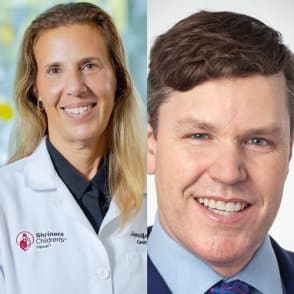
Bob Underwood, MD (Host): Welcome to Pediatric Front Lines from Shriners Children's, where we explore the best in pediatric care. I'm your host, Dr. Bob Underwood. Over the past decade, anterior cruciate ligament or ACL injuries in pediatric and adolescent athletes have more than doubled, driving renewed interest in biologic and tissue preserving approaches to ACL treatment.
Today, we'll explore how innovations fit alongside established standards of care. So joining us today are Dr. Sean Waldron and Dr. Jennifer Weiss, who will bring complimentary perspectives on ACL injury and ACL Injury Management. Doctors, welcome to Pediatric Front Lines.
Sean R. Waldron, MD: Thanks, Bob.
Jennifer M. Weiss, MD: Thank you.
Host: So this is really interesting and really advanced stuff. Let's start by talking about kinda what is the gold standard. Dr. Weiss, before we talk about the newer approaches, can you really walk us through the most common traditional ACL reconstruction techniques used today? And what would you consider a gold standard? And why would you say that's gold standard?
Jennifer M. Weiss, MD: Yeah, that's a great starting point. So the most traditional management of a young athlete who tears their ACL, first of all, the first bridge that we consider is this, this person an athlete, and do they need surgery? And I would be remiss if I didn't mention that some people don't. If they're not an athlete, if they're not doing cutting and pivoting sports, there is a small population that may not be the right fit for surgery. And we have to think about their head space. So their emotional presence, their family's ability to follow through. So I know that's not what we're going to talk about today, but I don't want us to forget that not everybody needs surgery.
If somebody does need surgery, the gold standard is an ACL reconstruction. The difference between reconstruction and repair is repair is we're bridging together tissue that already exists versus reconstruction is we're taking other tissue to replace anatomically, in most cases, tissue that is torn up and cannot be repaired or salvaged. So the gold standard, for the young athlete is autograft, meaning from their own body. Not cadaveric. That's gold standard to take their own tissue. And then there's three main choices that probably still have equipoise in terms of where we take the tissue from. One in equipoise, meaning they're all evidence-based about equal. One is the patella tendon, which is the area that connects the kneecap down to the shin bone. The second is the quadriceps tendon, which is the area that connects the thigh muscle down to the kneecap. And then the third is, the hamstring, which runs behind the knee. So that's gold standard, historically for the young athletes.
Host: And about how many of these ACL reconstructions have you performed using those particular approaches?
Jennifer M. Weiss, MD: So there's gray hair under these blonde fake highlights. I've been doing this for 23 years. And in a former life, I was doing close to a hundred a year, so I've done a lot of these.
Host: You mentioned graft choices. What patient injury characteristic would influence your graft choice in your particular practice?
Jennifer M. Weiss, MD: So, for me there's characteristics about the patient in terms of their demand, in terms of are are they a large football player, in which case the gold standard is probably in the NFL physicians still consider gold standard for them, the patellar tendon. And then depending on demand as well as body habitus, then we move into quadriceps and hamstrings. One of the issues, especially for the younger women athlete, is sometimes people have a predilection for pain in the front of their knees. Something called patellofemoral syndrome or anterior knee pain. If they have that predilection, I'm not going to use their patellar tendon because it increases their risk of having that in the future.
Host: So with that foundation, Dr. Waldron, can you outline the principles behind this bridge-enhanced ACL restoration or BEAR, and how it differs mechanistically from conventional reconstruction, and how does the biologic rationale of BEAR compare to graft based approaches?
Sean R. Waldron, MD: I'm going to back up actually a little bit and I'll explain why reconstruction became the gold standard, and that's because many, many years ago, surgeons would do repairs, and they found that the failure rate, meaning the recurrence rate was unacceptably high and they were looking for another way to treat this problem. And so they started doing reconstructions and that's been the gold standard for a very long time.
Somewhat recently, a doctor at Boston Children's, Martha Murray started doing some research looking at the possibility that you might be able to repair the ACL. And interestingly, she started this research back in 1989, but it wasn't until 2020 that the BEAR, which is bridge-enhanced ACL repair, and I'll just say BEAR from now on because it's easier, became FDA approved for use in patient's.
In 2015, that was the first-time that she did the first BEAR actually, the first surgery while she was researching it. And what she looked at was the fact that the ACL is a ligament that's inside and inside the knee joint. It's pretty rare that we are dealing with having to do surgery on ligaments, inside joints.
A lot of the ligaments that are injured, are outside joints, and they heal fine. So the example that I would give would be the MCL. So the MCL, the medial collateral ligament, it tears every once in a while. It heals pretty much on its own. The reason for this is that it forms a blood clot to bridge the area that was torn and then it heals through that blood clot.
The problem with the ACL is that the blood clot that forms is on the inside of the knee joint and the synovial fluid inside the knee joint tends to break down the blood clot and prevent the ACL from healing. And that's why ACL reconstruction became the gold standard. Well, Martha said, well, what if we could come up with a material that would bridge that gap and keep the blood clot there, protect the blood clot from the synovial fluid, breaking it down and allow the ACL to repair.
And that became the BEAR implant, which is a collagen based implant. It looks kind of like a marshmallow almost. It's about this big. And, the way that we do this surgery is, we repair the ACL, we put in this BEAR implant into the knee joint, and that protects the ACL repair. It stays around for about six weeks or so, and then it actually dissolves away, so it's not there anymore.
It's really changed the way we look at possible treatment options for the ACL, because as you can guess, doing a reconstruction, requiring taking a piece from somewhere else is going to have effects on that area of the body. And if you don't have to do that, then that's an advantage.
Host: Yeah, it would be a huge advantage. I would see that. So what limitations or unanswered questions in traditional ACL reconstruction did BEAR aim to address? And in what scenarios does it offer a meaningfully different option?
Sean R. Waldron, MD: So the main difference is that in ACL reconstruction you have the graft. That's what we call the piece of the tendon that's taken for the reconstruction, you have what's called graft-site morbidity. So you have the different options that Dr. Weiss was just talking about.
The, quadriceps or the patellar tendon, or the hamstring tendon. Taking a piece of that tendon is always going to cause some sort of an effect, some weakness at some point, you know, initially, that patient needs to rebuild. Rebuild that area of their body. So doing the BEAR will take that part outta the equation and make the rehab a little bit easier.
There's also a couple other things that kind of came about surprisingly, during the research. In the animal models, they found that there was a decreased rate of osteoarthritis in the animals that had BEAR versus ACL reconstruction. Now we won't know if that's the case in humans for many, many years, so we can't answer that question, but it's a theoretical possibility that that's a good option.
In terms of the graft site morbidity, though, you can imagine that a patient that has a BEAR is going to have a somewhat easier rehab compared to the reconstruction, because they don't have that other surgical site. What I found is that those patient's do seem to be ready for returning to their activities a little sooner.
Host: And that's phenomenal. Dr. Weiss, from your perspective, where does a repair-based approach like BEAR fit within the current ACL treatment algorithms?
Jennifer M. Weiss, MD: I'm going to throw two curve balls if that's okay. Curveball number one is that there's also a setting, a very limited setting in which some of us believe a repair is okay even without the collagen BEAR implant. And that is if the tissue actually tears right off of the femur or the thigh bone and there's enough tissue to get up there; some of us, myself included, very rarely will actually repair it right back up there. So that's one surgery that we all need to be prepared to at least consider. And then I'm going to throw a weirder curve ball and my last name is Weiss and there was another Dr. Weiss who was my dad and that guy in 1985, was part of a research project that took a carbon ligament that, contributed to enhancement in a similar fashion to what we're talking about. That ligament from 1985 to about 1989 looked like it was kind of doing okay. This carbon based implant. Around the late eighties, early nineties, it started to be understood that that wasn't a great option.
And so that's some of the history of where Dr. Murray kind of picked up. So I have a familial kind of bias toward an interest in this. So, this is not the first attempt to make a better milieu or environment for the ACL. And I am all for it. To me, what I want to be very careful of is, who is the right person for this?
My personal population of the patients that I take care of are very young and, even young for the Shriner system. I think Dr. Waldron and I may even differ a little bit in who we get to take care of, And the youngest patients have both for ACL reconstruction and for repair and for BEAR have the highest rate of re-tearing or messing up the surgery.
And so the youngest ones, Dr. Murray, in her literature and her science has showed us that they're the ones that under the age of 16 have a 27% rate of failure, and 16 to 17 have about an 18% rate of failure. And those aren't too different than from the ACL reconstruction. So the youngest patients in my hands are the ones that I don't tend to consider for this route. And then lastly, what I'll say is that what's awesome about the BEAR and any sort of repair is we don't burn any bridges. So if that kid happens to be the one in four or one in five who re-tears, we still have all of the options to reconstruct and we haven't done too much surgery. So no bridges burned is really important.
Host: And that's phenomenal. You still have that option as a follow on, in those rare cases. So Dr. Waldron, what does the ideal BEAR candidate look like? I mean, how important are factors like age, skeletal maturity, injury timing, those types of things?
Sean R. Waldron, MD: Well, interestingly, like Dr. Weiss alluded to, the most important is probably the tear itself. So the tear based on MRI and the tear when we look at it under arthroscopy. So we're looking at it, you know, with a camera and the more tissue you have left to repair where it tears off the femur, the better.
So if it's a mid substance tear or higher, then you have an option to repair it and use the BEAR. As Dr. Weiss says, if it's really high up there, really proximal, then you can just repair it. So, the minimum necessary is about a centimeter of tissue at the base where it inserts on the tibia.
So as long as you have at least a centimeter of tissue, you can repair it. The other thing that I think is probably more important than the time from injury is how healthy the tissue is. However that is related to time from injury. So if it's been maybe two or three months since the injury and we go in there to repair it, usually the tissue is pretty good.
Assuming it wasn't a significant tear where everything is completely torn up. Usually, when I'm hoping to do a BEAR or a repair, I go in there with the plan to suture it back together. And if it feels like, and this is a, you know, more of a surgical technique thing, if it feels like the tissue is holding the stitches well; then I know that it is repairable. And the other thing is that getting a sense of the blood flow to the ligament, which those are all surgical factors.
Now, age, interestingly, when the FDA approval first came through, they had restricted it to 14 and older.
But that has changed recently in the past year. And now there's no age restriction at all. So, it is approved for any age, and it is approved for kids that have open growth plates or closed growth plates. So those are all options. So that's actually not a limiting factor. The other part of the FDA approval is that they say that it should be done within 50 days.
I don't actually use that. I don't think that it should be that set. Like I said, the things that matter to me more are the quality of the tissue. So if it's been three months, if you've gotten to surgery three months from the injury and the tissue looks good, and feels good, then you can do the BEAR and it's not a restriction.
Even if it's outside that 50 days. Now, I'm sure there's a certain point where six months out maybe it's not a good idea, or maybe a year out it's not a good idea. And not like we're putting off surgery that long for these kids. It's more about patients that presented late. But just like with ACL reconstruction, the best results are when we can get to that patient, within a reasonable timeframe, within a couple months.
Bob Underwood, MD (Host): Absolutely. And Dr. Weiss, what factors would lead you to favor reconstruction over repair-based approaches?
Jennifer M. Weiss, MD: So number one, I agree with Dr. Waldron. It is about the anatomy and what I tell my patients is we're going to be making a game time decision. I tell them about the pros and cons of both surgeries and I'm prepared in my operating room to do both, the repair or the reconstruction every single time. And then once I get into the knee and I do something for the orthopedists of this generation, they don't do it as much, which is before I proceed with my surgery, I do an arthroscopy. So I actually get in there and I look and I feel, and I pull, and I have residents that are rotating with me these days saying, wow, I haven't seen people do that before. Because for efficiency's sake it does make a little bit more sense to go quicker, get in there, get your graft, get it going, shave off some time from surgery. I don't do that, because I want to keep the opportunity open. So it's very much about what anatomy that I see, how the tissue feels. And sometimes I will also do what Dr. Waldron is talking about, if I think that it's going to hold a suture, I will try to put that suture in and test it out.
Host: Absolutely. And I like your analogy that you're making a game time call. It's something that athletes, who we're talking about right now, they can relate to that.
Jennifer M. Weiss, MD: They do. They like that. They're like, we get that. You go coach.
Sean R. Waldron, MD: Can I add on something to what Dr. Weiss just said? I completely agree. It's also a game time decision for me, same exact thing. And I use that wording, so that's funny that you say that too. But the other thing, even before you start the arthroscopy, when the patient's asleep, I do an exam under anesthesia and that can sometimes change what I do.
So, we're not really talking about some of the other parts of ACL surgery today, but one of the surgeries that I'm sure we both do is something called a lateral extra-articular tenodesis. A little bit, probably beyond the scope of this conversation, but I do an exam under anesthesia to see how unstable the knee is, and sometimes that can push me to add on other surgeries.
So same kind of conversation that I have with that patient. We might do a repair, we might do a BEAR, we might do a reconstruction. We might even do this other thing that's called an LET and it's a whole other surgery that we do on the side of your knee. And it all just depends on how it looks when we're in there.
And we can't always tell that before the surgery. It's better done when they're asleep. So, just something I wanted to mention.
Host: Absolutely. The exam under anesthesia, is so important to be able to do when the patient actually is relaxed and you can actually look at that stability.
So, Dr. Waldron, how many BEAR implants have you performed now and what are some short and long-term outcomes that you have observed based on those implants?
Sean R. Waldron, MD: So I started using the BEAR implant almost three years ago. And that's when I did my first one. And over those years I've now done almost 20, I actually have one scheduled tomorrow, so we'll see how that one goes. I have been pleasantly surprised at the early outcomes. So out of that number, I have had zero recurrences, so no re-tears. A wide range of patient ages. In fact, the youngest that I've done this on is I believe 11 years old, so I have done it on a younger patient. And that boy is playing club soccer now and doing great. And I've had some football players in there and different types of athletes, and non-athletes too, thankfully.
And they're all in general, doing well. I have had one patient that I had to bring back to the operating room because she had what's called arthro pyrobrosis, which is knee stiffness. And that's a common thing, and I wouldn't say common. It's a risk in either surgery. The interesting thing about having a patient with that, that had a BEAR is that it gives us another look, to see how the ACL repair is healing. So this patient was around five months out from her original surgery. She was lacking about 20 to 30 degrees of flexion. She couldn't bend her knee all the way. So we took her to the operating room.
We cleaned up the adhesions and I got a nice look at the ACL repair and it looked like a normal ACL. It looked amazing, So, it was really exciting. And her knee was stable and we were able to get it to bend. So that's been the one patient that I had to take back and it was actually a really nice opportunity. I know that I'm not going to have zero recurrences for the rest of my career. I'm sure that some of them are going to retear and I'm going to have to deal with them. But as Dr. Weiss said, the nice thing is with that the studies have shown that the results of a BEAR revision to a reconstruction are better than if it was a revision from a previous ACL reconstruction. That's a really important concept that patients wouldn't really understand. But as surgeons, we think about it.
Host: Yeah, absolutely. And so Dr. Weiss, what outcome measures matter most when you're evaluating newer ACL techniques?
Jennifer M. Weiss, MD: The gold standard is the patient reported outcome. And so that's what we hang our hat on. However, it's really important for us as sports surgeons, to understand return to play and level of return to play. So those are the things that I'm the most interested in.
And I want to just circle back to one other thing that I've been thinking about a lot this week as I've been thinking about this podcast, which is the words that we're using ACL repair, reconstruction. And I'm actually going to be a linguist and go back to what Dr. Murray's been using in her titles, which is restoration.
And I think that that's the goal of this BEAR procedure is to actually restore. So I just think that's kind of cool.
Host: I do too. So Dr. Weiss, what do you think are the potential advantages of BEAR and where do you think its limitations remain?
Jennifer M. Weiss, MD: I'm going to repeat what Dr. Waldron said. There's no pain from where we take tissue to do a reconstruction. That's awesome. The recovery period is easier. And then I'm going to give a flip side of that is when patients have an easier recovery period, we're dealing with teenagers.
I have three teenagers in my family. They're weird. Like time of life people, right? I adore them. That's why I work with them. That's why I have them. However, they don't have a frontal lobe yet, and they need our frontal lobes. And what can happen during this recovery process is if they're feeling, there are some surgeons that taught me use a BTB, it hurts the most, and then they won't push it in the recovery before they're supposed to.
So then we've got the flip side of these people feeling really good. And I worry about that. I become very stern with my patients. If I am doing a repair, I become very stern about you better listen to me. Because your body's not going to give you the cues of pain.
Host: Dr. Waldron, how does that align with what you're seeing?
Sean R. Waldron, MD: Oh, I completely agree with everything she said. And the one thing that I want to talk about a little bit based on that return to play, so we have a pretty in-depth conversation with the family before the surgery about return to play just so that they know. And that's, usually the hardest part of the conversation is you will not return to full sports for at least a year.
And there's always tears. It's hard for them to understand. But then, our job becomes kind of a coach. We're coaching them along throughout this rehab process. And one other point I want to make, a bit of a pitch for the Shriner system. So, I myself utilize our motion analysis lab to determine readiness for return to sports.
It's an incredible opportunity. We have the largest system of motion analysis labs in the world. And we use them for all kinds of reasons. But my sports analysis for return to play is key in helping me to determine if kids are ready. And it's really not something that that many people do, and I find it to be a really useful tool for return to play.
Host: And I agree, having those discussions with athletes, they're generally highly motivated to participate and to compete. And sometimes it is hard to have that conversation to almost, in fact demotivate them or redirect that motivation. I think all of us have lived that.
Alright. The question that we often get as providers, if this were your kid, if this were your mom, that I don't know how many times I've been asked these questions in terms of taking care of patients. But here's the question. If this was your child and they met the criteria for both BEAR and traditional reconstruction; how would you think through that decision and what factors would weigh most heavily for you? Dr. Weiss, we'll start with you. You said you have teenagers, so let's ask that question and then we'll move over to Dr. Waldron.
Jennifer M. Weiss, MD: I actually have the, not, it's not one of my three children, but one of the best friends of one of my children tore their ACL on my watch last week on a ski trip. And this young woman is like a daughter to me, and I am in that position. I am rooting for her surgeon, who, it's not going to be me.
She's too close to me. I'm rooting for her surgeon to use quadricep tendon reconstruction if she's not fully repairable off of the femur. That's me being super careful and you already heard my bias of my dad's journey, so I'm still waiting. I'm on the sidelines waiting a little bit more about this BEAR and Dr. Waldron is teaching me a lot about it with his patients.
Host: That's awesome and great to hear from clinicians from multiple perspectives. Dr. Waldron, same question to you.
Sean R. Waldron, MD: I feel like I would have to be honest and say that the way that I treat my patients would be the way that I want my children treated. So I would expect, the same game time decision. You have the BEAR as an option, you have repair as an option. You have whatever reconstruction option would work best for that child and their age.
So yeah, certainly I would want to do the same exact thing. Now, my oldest daughter is nine years old. So, little bit of a different conversation for that age group. And my younger one is six, so, hopefully we don't have to have that conversation anytime soon.
Host: Indeed. As we're finishing up, is there anything that we haven't covered that you think referring clinicians should consider when they're counseling their families, or their patients about ACL treatment options today?
Jennifer M. Weiss, MD: I've been thinking through this so much in the last two years. I joined Shriners two years ago and I adore, adore this organization. And the biggest reason is I'm the same doctor. I'm the same surgeon as I was in my prior careers, however, what I have for my patient's here is this wraparound care and this ability to make sure that their therapy is not delayed or cut short because of authorizations and because of looking for insurance companies to agree with us about what they need.
So to me, what I tell the families is the therapy is as if not, and more important than me as a surgeon. And that means their participation with the therapy. So it's not just going to therapy and having therapy done to them, it is them doing their work in strength with the therapist is their partners. So I think that cannot be underestimated.
Host: We're all part of our own healing, I think is a really important message. Dr. Waldron, anything you'd like to add as we close?
Sean R. Waldron, MD: I don't know how Jen just stole my answer, but, that was incredible. So, one of the amazing things here is that we have a multidisciplinary clinic. So I have a therapist with me in my sports medicine clinic, and we work side by side. We're seeing the patient's together.
And so I'm getting the therapist in there, from the day we talk about surgery, to tell them about the rehab so that, you know, we're talking about rehab before we've even done the surgery and to show them the exercises they need to do. So I think the rehab is hugely important, in many ways more important than the surgery.
The other thing that I do want to touch on is the mental aspect of recovery. It's a huge surgery. It's a big hit to your body and it's hard to recover from. And, kids hit a lot of bumps along the way and you need to recognize that some kids might need some help.
I think that, you know, having a sports therapist is a really important part of the process as well. And just recognizing the mental aspect of all this.
Host: I think that that's huge and it speaks a lot to what is made available from Shriners Children's in being able to accomplish a lot of those multidisciplinary approaches. Thank you both for being with us today. This has been really educational for me, and I hope for everyone who's listening, we really, really appreciate your time today.
Sean R. Waldron, MD: Thanks so much.
Jennifer M. Weiss, MD: Thanks for having us.
Host: For more information, including the full range of care disciplines, please visit shrinerschildrens.org. To hear more pediatric frontlines episodes, please subscribe wherever you listen to podcasts.
About the Speakers
Sean R. Waldron, M.D.
Sean Waldron, M.D., grew up in Medford, New Jersey. He was inspired to go into medicine by his father, who was a primary care physician in Medford for 40 years. Dr. Waldron attended Johns Hopkins University as an undergraduate and then returned to New Jersey for medical school at Robert Wood Johnson. After completing his residency in orthopedics at Case Western Reserve University in Cleveland, Ohio, Dr. Waldron then moved to New Orleans to practice pediatric orthopedics at Ochsner Medical Center. He developed a special interest in pediatric sports medicine and cerebral palsy. After working in New Orleans for 11 years, he had the opportunity to move back to the Philadelphia area and work for Shriners Children’s. He started working at Shriners Children’s in 2022 and is excited to be able to work with the lower extremity team, especially in sports medicine and cerebral palsy, as well as the motion analysis center.
Learn more about Sean R. Waldron, M.D.
Jennifer M. Weiss, M.D.
Jennifer Weiss, M.D., chief of staff at Shriners Children’s Hawai'i, is a highly-skilled and accomplished pediatric orthopedic surgeon renowned for her expertise in pediatric sports medicine, sports injury and trauma surgery. She has a remarkable history of treating a variety of routine and rare orthopedic conditions in children. A graduate of Williams College, Dr. Weiss went to medical school at Mt. Sinai School of Medicine and completed her orthopedic training at Baylor College of Medicine in Houston, Texas. Her pediatric orthopedic fellowship was with Children’s Hospital Los Angeles / University of Southern California, where she stayed for seven years as director of the Pediatric Sports Medicine Program. In addition to an exhaustive list of national and international clinical presentations, journal publications, research contributions, academic appointments and accolades, Dr. Weiss holds professional and/or board memberships in the Pediatric Orthopedic Society of North America, the American Academy of Orthopedic Surgery and the American Academy of Pediatrics. She is also vice president of the Ruth Jackson Orthopedic Society.


Keep In Touch
Join our mailing list to stay up to date on everything that's happening at Shriners Children's.
Next Steps
Share Your Story

Give to Shriners Children's

