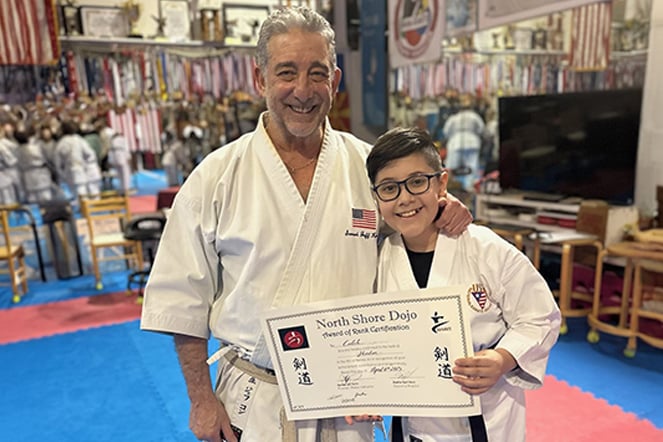
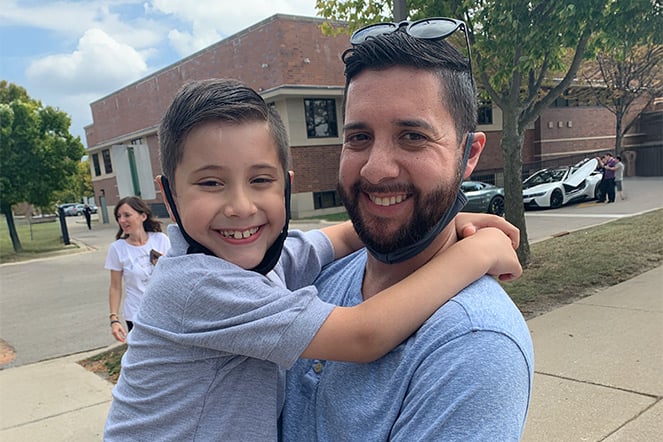
You may not know what it means to experience spastic diplegia cerebral palsy (CP).
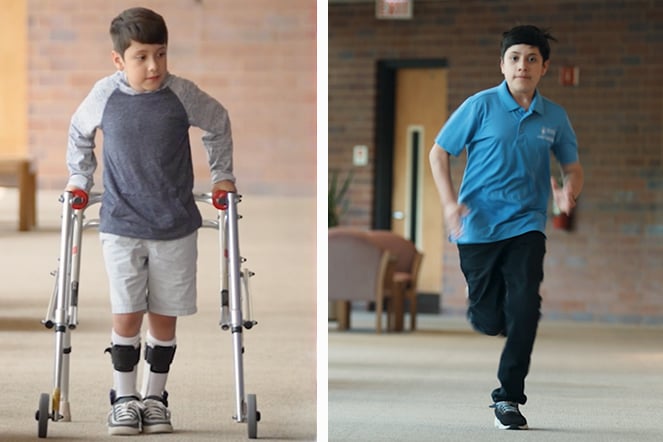
So let Caleb, 13, explain what it’s like: “It happens in my legs where some of my muscles are very tight, and they need to be loosened,” he said. Describing his legs before treatment, he said they were “kind of bent inwards.”
CP is a brain paralysis or weakness. “His cerebral palsy affects how he walks,” said Kenia, Caleb’s mother. “When his brain tries to tell him that he should do something, his brain tells it, but it doesn't send the message all the way down to his leg.”
“My mind is telling me that my body should be able to do something, but the body’s just not responding,” Caleb said.
The family’s search for medical answers started when he was a toddler. Kenia knew something was not right with her son’s movement, and then he began missing developmental milestones. They came to Shriners Children’s at the suggestion of their family, who found help for scoliosis, another orthopedic issue.
Shriners Children's Chicago is a destination hospital for families where children ages birth to 18 find hope and answers to regular and rare orthopedic conditions affecting a child’s physical development. As part of the Shriners Children’s mission, all care and services are provided regardless of the families’ ability to pay or insurance status. This allows doctors to consider all options for each child.
Caleb’s father, Alex, said the experience at Shriners Children’s was different from day one. Testing and evaluations with physicians who specialize in CP, including a pediatric orthopedic surgeon and pediatric neurologist during the same visit, showed Caleb was an “anomaly.” Dad recalls doctors explaining their son had symptoms consistent with CP but no sign of brain trauma (such as a stroke or abnormality before or during birth) that would cause disability.
“From day one we left with the equipment, and we left with a plan of action, and sort of like a promise that we’re going to figure this out. And it’s been a promise kept ever since,” he said.
Treatment included botulinum toxin injections and physical therapy to help reduce the muscle tightness caused by CP. Over the years, Caleb’s family also navigated daily challenges, including helping him get dressed.
“The struggles with shoelaces, putting on pants because the legs are really tight … him wanting to be independent. But then also being overly careful about him not falling and hitting his head,” Alex said.
Along the way, Caleb’s family, in close partnership with his care team, faced difficult decisions about two major surgeries. One complex procedure, selective dorsal rhizotomy, involved cutting spinal nerves responsible for much of his muscle tightness. Later, Caleb underwent a double osteotomy, during which surgeons cut and realigned both femurs to improve the positioning of his hips, legs and knees. After surgery, the family knew they would return to Shriners Children's Chicago for inpatient rehabilitation, where the medical team and environment had become a special place for them.
“After surgeries, children often need intensive physical therapy because their bodies move very differently than before surgery. The muscle tightness they relied on for movement may be reduced, and their bony alignment has changed, so they must learn how to move with new and more efficient movement patterns,” said Jenna Clancy, PT, DPT, a physical therapist who treated Caleb at Shriners Children’s. “Following this type of surgery, children may feel like they are in a new body, so physical therapy is essential to rebuild strength, balance, coordination, flexibility and endurance.”
Inpatient therapy helped Caleb relearn to walk. “Physical therapy will typically start with practicing standing and weight shifting. When starting to walk, the patient will gradually transition from more to less restrictive assistive devices. Over the course of several months, Caleb started off walking with use of a reverse walker, progressing to forearm crutches, and eventually he advanced to ambulating [walking] without an assistive device,” said Clancy.
While important work, our therapists make it fun for the patients too. “I used to do a lot of games (in physical therapy) and stuff because I didn’t really want to do any of the things they wanted me to do,” said Caleb. He recalls that a favorite activity was standing on a half-circle balance platform while building Legos. And he loved the always-popular warm-water therapy pool. “I used to do so many fun games in the (hospital) pool.”