


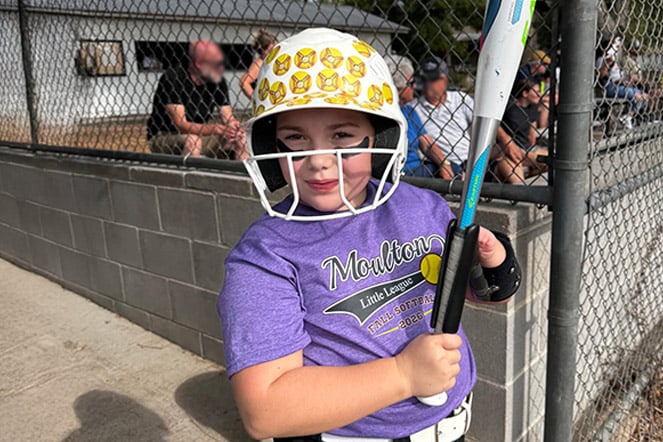
Claera holds her bat with a special device made by the POPS team.
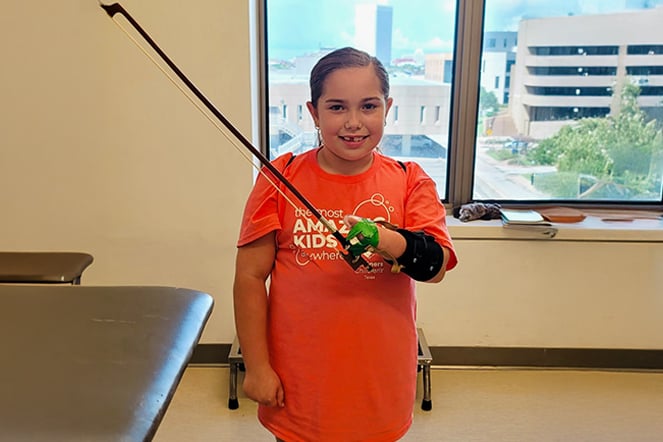
Claera shows off her custom device she uses to help her play the violin.
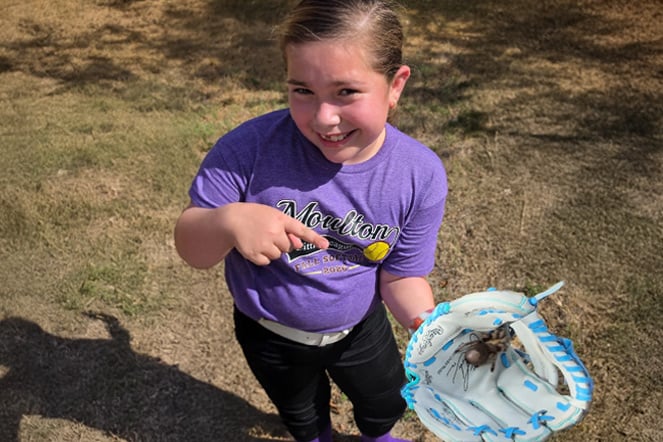
Claera shares a playful moment with Rexy, her pet tarantula, in a softball glove.

Claera is reaching for her goals.
The answer guides everything that follows. Rather than focusing solely on a diagnosis or condition, the care team works closely with patients and their families to identify personal goals and develop solutions that help make them possible. That approach is what brought 9-year-old Claera to Shriners Children's Texas.
Like many children her age, Claera has a number of interests. She loves playing softball, enjoys creating crafts and wants to learn how to play the violin. Born with a limb difference affecting her left hand, Claera can sometimes face challenges when doing certain activities. Now, thanks to support from Shriners Children's Texas, she is getting additional tools to help her do even more.
When people ask about her hand, Claera's answer is simple: "That's how God made me."
It is a response she has repeated often, especially after moving to a new school where classmates were curious about her difference. Rather than feeling self-conscious, Claera has learned to answer confidently. Her focus is not on what she can't do. It has always been on what she wants to accomplish.
Claera recently began playing softball, taking on the position of catcher. Because her left hand is affected by her limb difference, using a softball glove can be challenging. At Shriners Children's Texas, the Pediatric Orthotic and Prosthetic Services (POPS) department is fabricating a custom piece of equipment designed to help her wear and control her glove more effectively. The in-glove device is based on one that belongs to a family friend with a similar limb difference, originally developed by Shriners Children’s Texas in the 1980s.
That's how God made me.
The POPS team is also working on another tool to help her play music. Inspired by her father, a violin player, Claera wants to learn the instrument herself. Traditional violin technique requires right-handed players to hold the violin's neck with their left hand while controlling the bow with their right. For Claera, that approach isn't practical. Instead, she plans to reverse those roles, holding the violin with her right hand and using her left hand to operate the bow with the assistance of a custom prosthesis. As luck would have it, with a simple component switch, the violin-holding device can also be transformed into one that can assist her in holding a softball bat, bringing her interests full circle.
“I am making Claera a custom violin prosthesis that allows her to utilize her natural wrist motion that is convertible to a batting prosthesis, and a separate softball mitt filler/prosthesis modeled after a device her neighbor received from Shriners Children’s Texas 40 years ago,” said Hannah Zesiger, MS, L/CPO, a certified and licensed prosthetist in POPS.
For Claera's parents, the objective has never been to set limits. Instead, they focus on solutions whenever a challenge creates a barrier. Their goal is to make sure Claera has opportunities to pursue the things that matter most to her. That philosophy aligns perfectly with the mission of Shriners Children's.
Whether a child wants to play sports, perform music, participate in recreational activities, or simply gain greater independence, the care team works to find practical solutions that support those goals. Every adaptive device begins with understanding what success looks like for that individual child.
For Claera, success means catching softballs, learning violin, creating crafts and enjoying life alongside her siblings. Her story is a reminder that determination often matters more than limitation, and that with the right support, children can pursue their passions on their own terms.


