Finding the Right Fit
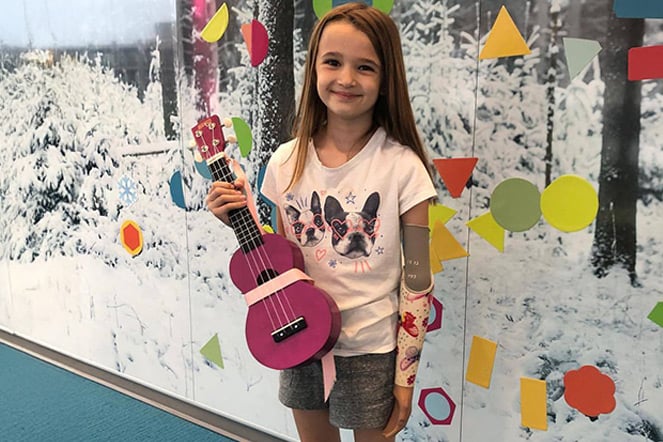
By the time she was 7, Shelby had already learned how to navigate the world in her own way. But as she grew, she and her family began looking for options that could support her budding independence and help her feel more balanced.
At Shriners Children’s Lexington, they found a team ready to guide them through every step. Her care team includes Janet Walker, M.D., and Eric Miller, a certified prosthetist and manager of Shriners Children’s Lexington Pediatric Orthotic and Prosthetic Services (POPS).
“The community here is great,” she said. “Everyone always makes me feel welcome.”
Shelby said she’s never even had a visit where she wasn’t offered snacks. “I love that Shriners Children’s isn’t just a place that people work,” she said. “You can tell that everyone cares here.”
Shelby’s first prosthesis was a cosmetic arm, something she chose to help fill her shirt sleeves and feel more like other kids her age. It gave her confidence, but over time, her goals began to shift.
When she was ready to explore new options, her care team took the time to walk her and her family through every possibility, explaining the differences and focusing on what would work best for her.
That’s what Shelby’s mom loves about Shriners Children’s Lexington. “I know that Shriners Children’s, regardless of a family’s financial situation – if they have insurance or don’t – they’re going to do what’s right for the kid,” Christy said. “They’re going to show all the options, lay out the pros and cons, and then let the child make the decision that’s right for them.”
A New Level of Independence
Shelby eventually tried a myoelectric prosthesis. While advanced, it proved difficult to control and did not give her the function she was hoping for. Still, the experience helped her better understand what she needed.
In 2024, Shelby returned to Shriners Children’s Lexington to try something new.
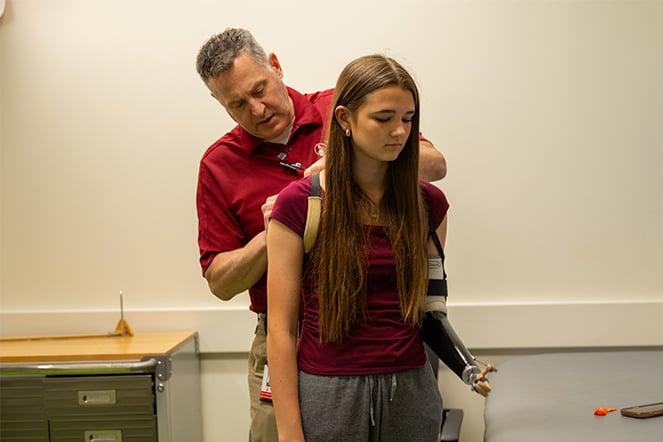
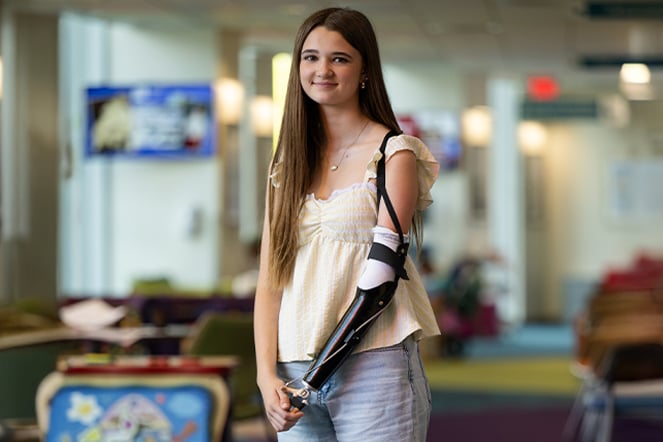
Working with her prosthetist, Shelby chose a body-powered prosthesis that better matched her lifestyle. Together, they customized a lightweight device designed to support her everyday activities.
“I already had a cosmetic prosthesis, so I didn’t really want to do that at that point,” Shelby said. “I’d already had a myoelectric arm which was too heavy, so I knew that I wanted one that was functional but wasn’t going to be too heavy because I did not have a ton of muscle to move it. So, the prosthesis that best fit my needs was body-powered.”
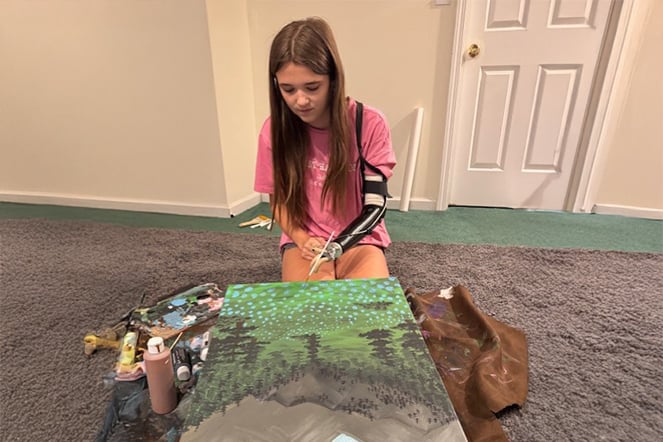
Learning to use it took time and determination. Shelby practiced every day, building strength and control. She learned how to open water bottles, hold paper, pick up small objects, and eventually write.
“I actually had better control over my prosthetic than I thought I would,” Shelby said. “It was really cool to be able to build those skills.”
Eric Miller, Shelby’s longtime prosthetist, said Shelby can do all the things she does because she practices with her prosthesis every day. “She wears it and practices all the time,” Eric said. “It’s not, ‘OK, I’m going to put this harness on, and tomorrow, I’m going to be writing like Shelby.’ No, it takes time.”
Shelby said her body-powered prosthesis is also more durable, which allows her to feel more comfortable using it every day. “There aren’t a lot of things that I’m not able to use it for or choose not to,” she said.
The only time Shelby doesn’t really use her prosthetic arm is when eating dinner with her family or playing soccer.