


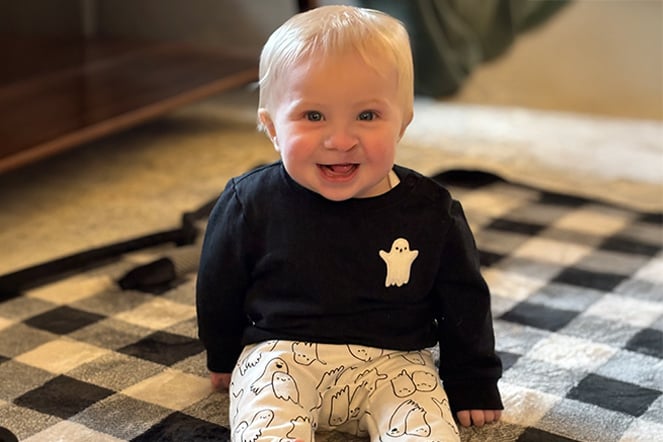
Dottie smiles brightly in her seasonal ghost outfit.
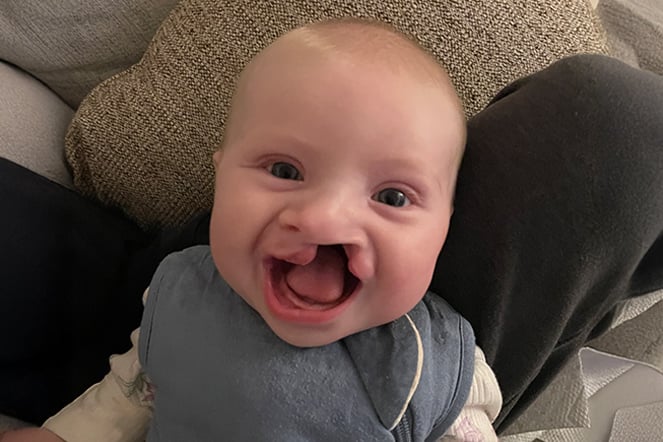
Dottie enjoys some pillow time.
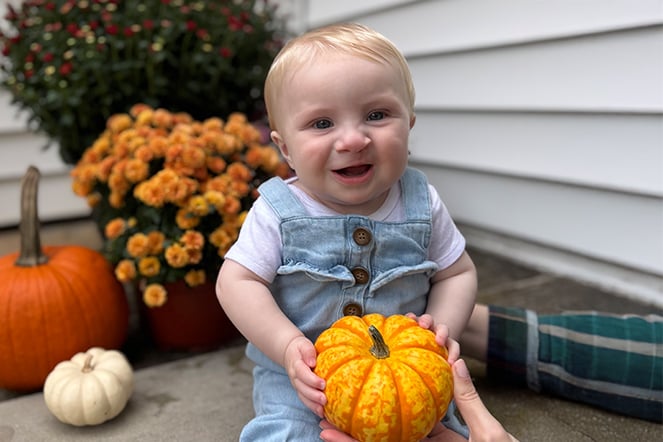
Dottie poses with some festive fall decorations.
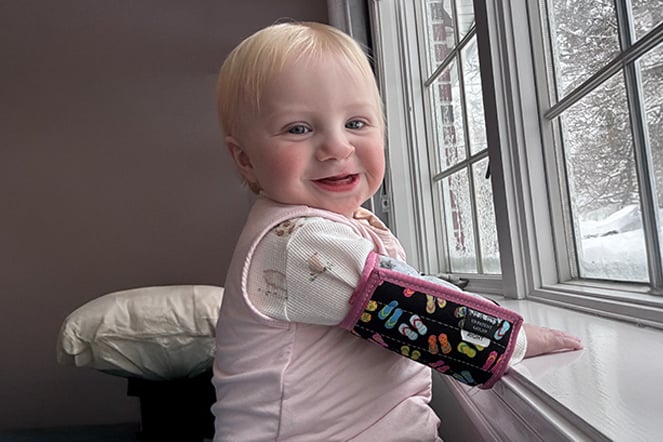
Dottie takes in a wintry scene.
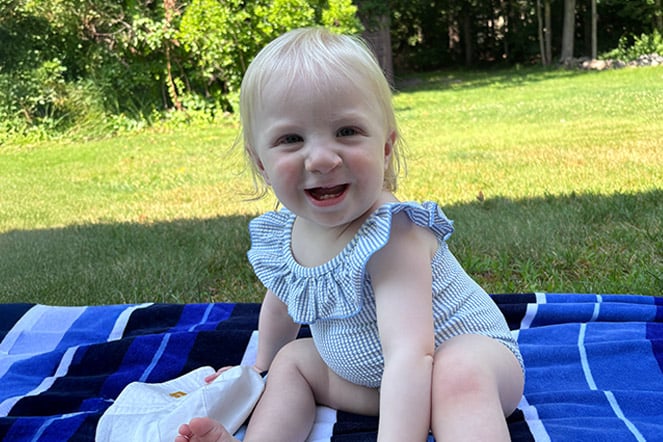
Dottie enjoys her book while taking in some fresh air.

Shriners Children’s Boston is highlighting our craniofacial care during July as part of National Cleft and Craniofacial Awareness and Prevention Month.
Andrew and Ellen learned their daughter Dottie would be born with a cleft lip, and possibly a cleft palate, during their 20-week anatomy scan. Clinicians recommended a fetal MRI for more detailed imaging and gave the family a list of facilities for the additional testing. Ellen and Andrew called every place on the list to get the procedure scheduled quickly. They heard back first from Mass General, where Ellen had the MRI. While at Mass General, the family also learned about the Cleft and Craniofacial Center, a collaborative program in partnership with Shriners Children’s Boston.
“After the MRI results were in, we met the rest of the craniofacial team, including Dr. Ranganathan and after that, it was an easy decision to bring Dottie to Shriners Children’s Boston for care once she was born,” Ellen said.
Kavitha Ranganathan, M.D., is a board-certified plastic surgeon and the co-director of the Cleft and Craniofacial Center. The cleft and craniofacial program at Shriners Children’s Boston is verified by the American Cleft Palate-Craniofacial Association. In one appointment, patients have access to all the specialists they might need over the course of their treatment. This includes nutritionists, speech therapists, oral and maxillofacial surgeons and orthodontists.
Before Dottie was a year old, she had three surgeries. Dottie was born with a wide cleft lip and palate, which means there is more distance between these separated sections of the mouth. To help address this, Dr. Ranganathan first performed lip adhesion surgery on Dottie when she was 12 weeks old, which helped narrow the gaps. “That surgery was followed by the cleft lip repair 10 weeks later, then the palate repair,” Ellen said.
Dr. Ranganathan explained that “the palate repair is done in a single-stage operation around 12 months of age to optimize facial growth and help with speech development.”
Now fully healed from her initial surgeries, Dottie will return for yearly check-ups for the next five years. At that point, Dr. Ranganathan will assess the need for additional surgeries, including bone grafting. Children born with a cleft can benefit from a bone graft to help anchor their permanent teeth. “Children with clefts of the gums require bone grafting to support proper dental development. It also helps enhance beautiful and functional smiles,” said Dr. Ranganathan.
As Ellen and Andrew navigated Dottie’s cleft diagnosis, they felt supported. Nurse care manager Sandy Barrett, BSN, RN, CCM, was a particular source of comfort. “Sandy was great. I’ve emailed her questions, and she is always very responsive. When we have needed a more detailed explanation about something, Sandy has always been there,” said Ellen.
Sandy explained that the care management team engages with families even before their child’s initial appointment, answering questions and explaining what to expect. “We also help connect families with other team members as their child advances through different phases of craniofacial care,” she said.
Know that you are not alone; you have an entire team with you. We were overwhelmed, but they were not.
A vivid memory that stands out for Ellen and Andrew involved a hospital stay for Dottie. “She was healing well from the surgery, but she just wasn’t interested in eating, so she was admitted. Dottie was on the inpatient unit for five days,” Ellen said.
Hospital staff gave Dottie two milkshakes with ice cream in special feeders to make it easier for her to drink. One was strawberry and the other squash. Ellen and Andrew laughed as they recalled how Dottie would point between the two milkshakes to indicate which one she wanted. “She loved both flavors and this approach magically unlocked her interest in eating again,” Andrew said.
Now that Ellen and Andrew have some distance from Dottie’s diagnosis, they have had time to reflect on those first few months of uncertainty. “We were very nervous, surprised and scared when we first learned Dottie would be born with a cleft lip and palate. Shriners Children’s Boston walked us through everything,” Ellen said. Andrew added, “Know that you are not alone, you have an entire team with you. We were overwhelmed but they were not.”
Ellen and Andrew participate in the Craniofacial Patient and Family Advisory Council, which they have found to be a valuable resource. “The meetings are a dedicated time to talk about some of the issues you are experiencing and to learn from other families, which is helpful,” Ellen said.
“We have met families with children close to Dottie’s age through the council, and it’s also helpful to talk with parents of older children to understand what we might be experiencing next. Firsthand experience is much better than learning from a textbook,” Ellen said.
Dottie’s parents describe her as a happy, giggly child who likes to blow kisses. She also loves to eat now. “Dottie was never the biggest fan of eating and now we can’t get her out of the highchair,” Ellen said.
As Andrew and Ellen look back on the first year of their craniofacial journey, they are filled with gratitude. “We are grateful that we have had guidance throughout the process. The first year was hard, but we got through it with the support of the Shriners Children’s Boston team,” Andrew said.


