


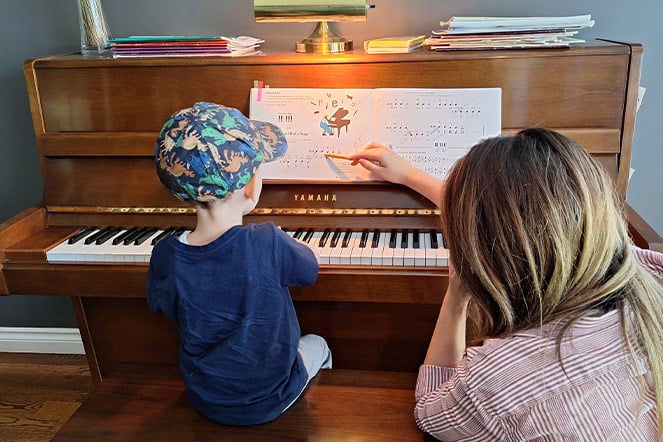
Donovan sits at the piano to practice his singing.
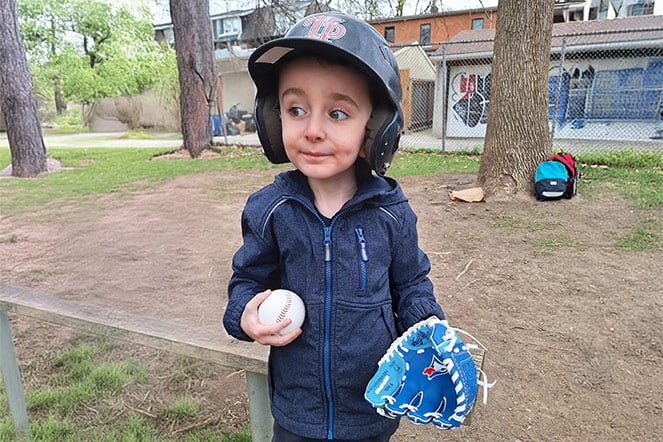
Donovan thinks about his next throw.
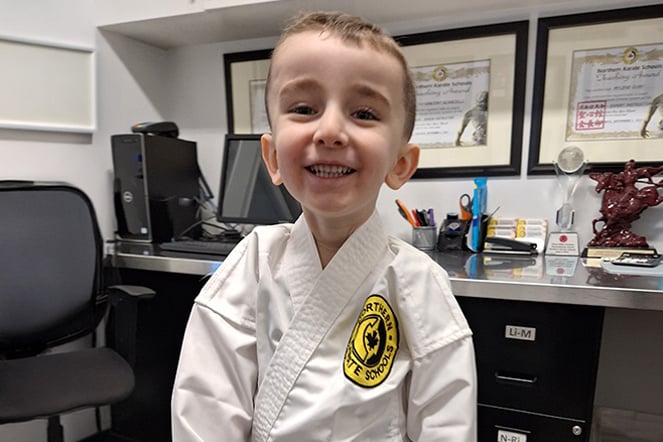
Donovan gets ready for his karate session.

What people don’t see is the routine that surrounds those moments – the careful monitoring, the daily adjustments and the brace he wears almost every hour of the day. It is the result of a medical journey that began before he spoke his first words.
When Donovan was 4 months old, a slight curve in his back caught his mother’s attention. At first, medical professionals suggested the curve would likely resolve as he grew and gave reassurance to Donovan’s mother, Pamela. But as months passed, the curve continued to increase.
Pamela consulted several doctors, but none were able to provide a diagnosis. Instead, they explored different treatment options. Chiropractor appointments became routine, visiting several times a week for nearly a year. Behind those efforts, Pamela sensed that something wasn’t right.
By the time Donovan was just over a year old, Pamela’s urgency grew. A physical therapist recommended immediate hospital care. An X-ray at their local hospital in late December confirmed Donovan had scoliosis, the curve in his spine measuring 32 degrees.
The diagnosis was clear, but what followed was not.
Pamela was told she had to be put on a waiting list. She soon received a letter stating that the first appointment was scheduled for April. Pamela made calls and sent emails requesting earlier openings, but each went unanswered.
By the end of May that year, when Donovan was finally seen, the curvature in his spine had progressed to 65 degrees.
“It’s not getting better – this is getting worse,” Pamela said, recalling the moment the situation became undeniable. It appeared the waiting had come at a cost.
What came next was unexpected.
Through an online support group, another parent suggested Shriners Hospitals for Children Canada. Pamela submitted an application the same day and within weeks, Donovan had an appointment. By July, he was under the care of a specialized team.
Treatment began with a brace in August, reducing the curve from 65 to 44 degrees, but the improvement was not enough. In October 2023, Donovan began Mehta casting – a more intensive option for early-onset scoliosis.
“For Donovan specifically, we had to pivot from our new normal which is using bracing to treat infantile scoliosis. In the past the routine was to use scoliosis casts that were changed in the operating room approximately every three months for 2-3 years. But nowadays, because of our strong partnership with orthotists, we having been managing these patients very well by bracing alone. Interestingly, in Donovan’s case, the brace was just not sufficient, and therefore, we had to pivot back to the method of casting under anesthesia. Fortunately, after numerous casts, we have been able to loosen up his spine and get him back into a spine brace for the time being with very encouraging results. He started with a scoliosis of over 50 degrees, and we have him down to around 20 degrees now,“ said Neil Saran, M.D., FRCS(c), Donovan’s surgeon.
Each cast covered his torso, staying in place for months at a time. The first was the most difficult. The rigid cast caused severe skin sores that were painful, persistent and serious enough that stopping treatment became a possibility. For any parent, watching a child endure that kind of discomfort brings its own weight: the tension between knowing the treatment is necessary and seeing the toll it takes. A solution was eventually found, and with specialized care and treatment, the sores healed and the casting continued.
Slowly, the results followed as each cast brought improvement. The curve was reduced further, eventually reaching about 36 degrees. Through nearly two years (eight casts in total), progress came one step at a time.
It was hard. It was very hard, but Donovan is such a resilient little boy. I am so grateful casting made the difference.
In June 2025, the cast came off and Donovan transitioned back to a brace – now worn 23 to 24 hours a day, with both daytime and nighttime versions.
For both Pamela and Donovan, life looks different now. It is more predictable and stable but still shaped by careful attention. There are new routines: removing the brace for sports, checking for skin irritation and attending follow-ups every six months.
Donovan’s scoliosis is classified as idiopathic with no confirmed cause. He will likely need to wear braces until his teenage years, and only then will it become clear whether surgery is necessary. For now, the focus remains on progress and preserving the life he enjoys.
For his family, the journey has left a lasting perspective, one shaped by uncertainty, advocacy and relief.
“There was a point where I just knew something wasn’t right,” his mother said. “You have to trust that instinct.”
That instinct, and the actions that followed, helped change the course of Donovan’s condition. The road ahead is still unfolding, but for Pamela and Donovan it no longer feels uncertain; rather, a path forward.


