


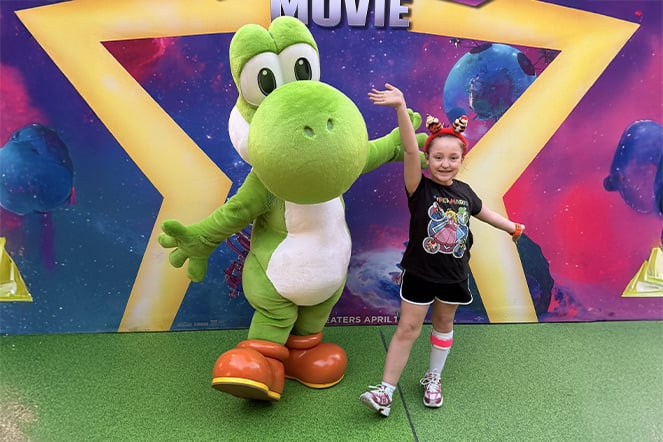
Louise meets Yoshi from Mario World.
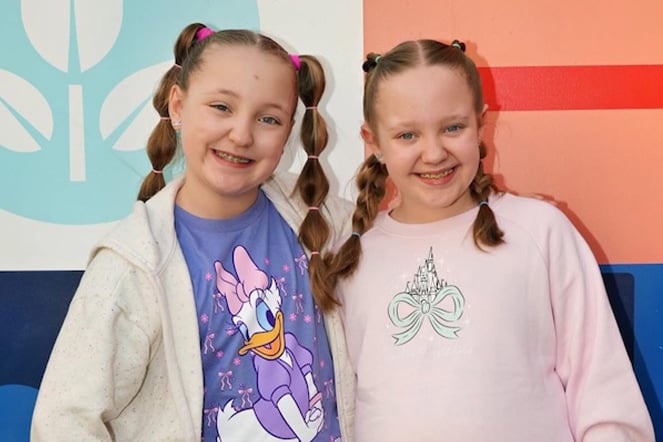
Louise and her twin sister, Elizabeth, stand together on vacation.
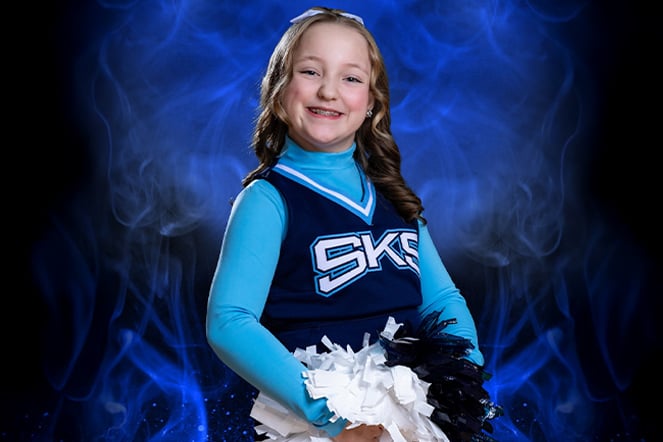
Louise shows off her cheerleading uniform.
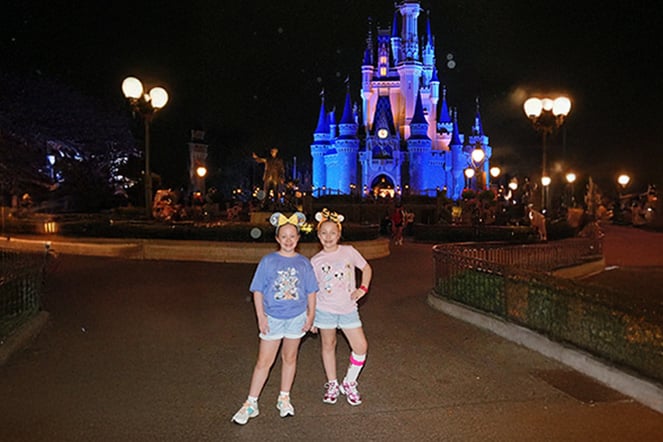
Louise and Elizabeth enjoy a night together at Magic Kingdom in Orlando, Florida.

Born prematurely at 34 weeks and after a short stay in the NICU, Louise – “Lou” for short – was able to go home. As she grew older, her parents, Andrea and Brian, realized she was not hitting her developmental milestones at the same rate as her twin sister. They were reassured that this was only because Louise was born prematurely, and were advised to continue monitoring her progress.
When Louise was 9 months old and began to crawl, her parents noticed that her left leg dragged behind her, so she began outpatient physical therapy near their home. She was monitored through Early Intervention’s tracking program every three months and qualified for physical therapy at 13 months old. Four months later, her early intervention physical therapist recommended a follow-up with orthopedics, who then referred Lou to neurology. After evaluation and a series of tests, it was determined that Louise had experienced a stroke in utero, leading to a diagnosis of mild cerebral palsy with left hemiplegia. After years of physical therapy, occupational therapy and bracing at other medical facilities, Louise and her family came to Shriners Children’s Philadelphia for a second opinion in August 2025.
During that initial appointment, Louise underwent a gait analysis in our motion analysis center (MAC). This state-of-the-art facility evaluates movement and collects data to help her care team develop a customized treatment plan. For Louise, this includes guidance under pediatric orthopedic surgeon Sean Waldron, M.D., and customized braces made in our Pediatric Orthotic and Prosthetic Services (POPS) department.
“We utilized the motion analysis lab to analyze Louise’s gait and provide objective data to determine the best treatment options. Based on this study, we realized that Louise’s AFO (ankle-foot orthosis) was likely overkill for controlling her foot position. We settled on a less bulky SMO brace that helped normalize her gait while still allowing her to be more independent. She was a great patient for our MAC lab.” said Dr. Waldron.
Louise loves coming to Shriners Children’s Philadelphia because everyone she meets is happy and talks about who she is, and not just about her cerebral palsy.
Louise has many hobbies, including dancing, choir, theatre and competitive cheerleading. She still uses a flexible plastic AFO called a posterior leaf spring for more strenuous exercises like cheerleading. “The AFO helps to make sure she can do all the moves she needs to help her team win! I have been so proud to be involved in her care and am excited to keep collaborating with her and her family on how best to support her needs,” said Rebecca Suddaby, MSPO, (L)CO.
“We are extremely happy with the care we have received at Shriners Children’s. We love that it feels like individualized care where the providers take extra time to talk with the families and patients, and care about the entire person rather than just the concerns at hand,” said Andrea, Louise’s mom.
At Shriners Children’s, the team can come together to enhance the care plan and ensure the patient can accomplish all they are looking to achieve. With POPS, the MAC and outpatient clinic in one building, the clinical teams can do just that: wrap-around care for the patient and family. We look forward to seeing all that Louise will accomplish in the future.


