


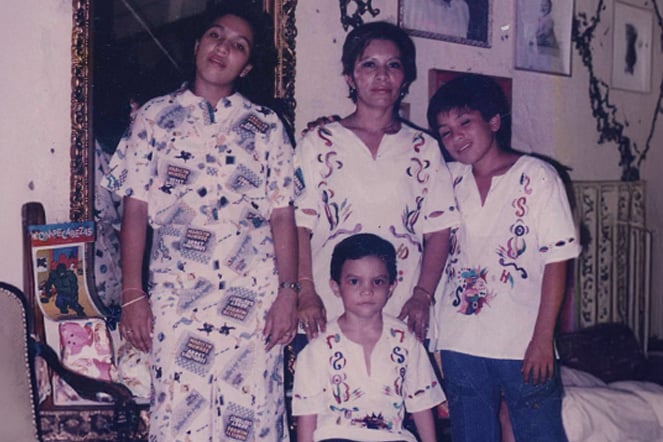
Eduardo spends time with his family in Nicaragua.
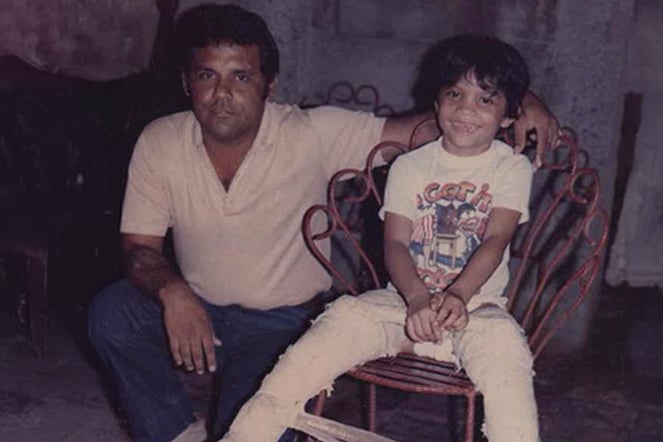
A young Eduardo smiles in his leg casts.
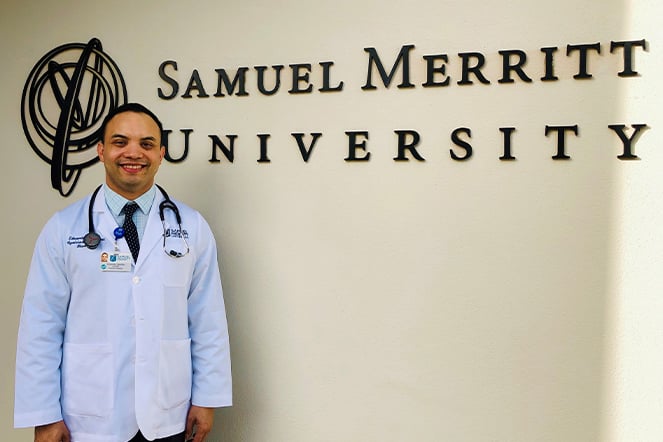
Eduardo stands in front of the Samuel Merritt University sign.
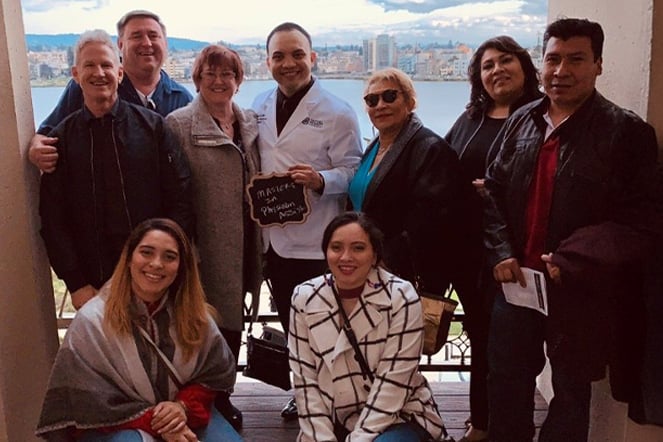
Eduardo gathers with family after graduation.

It was a journey fueled by hope and a mother’s determination to find an end to a painful cycle of treatment for her son.
Eduardo had been diagnosed with Legg-Calvé-Perthes disease when he was 4, a condition caused by disrupted blood flow to the femoral head of the thigh bone. This may result in necrosis and collapse of the bone in the femoral head. When blood stops flowing to the femoral head, it begins breaking down and losing its round shape, making it difficult to fit and move in the hip socket as it should. This impacts mobility, causes pain, and can lead to early-onset osteoarthritis.
For three years in Nicaragua, his treatment consisted of Petrie long-leg casts – three weeks on, one week off – for an undetermined amount of time.
“I was in a chair all day, with wood rods between my knees and ankles,” Eduardo said. “The week the cast was off, I was told not to weight bear by walking or running, but of course, I would still run around.”
During a visit by Shriners Children’s providers to Nicaragua, his mother learned that better, more definitive treatment was available in the United States. As a single mother, she made a life-changing decision, selling her business and moving her family to Sacramento to be near the care at Shriners Children’s Northern California in San Francisco.
At Shriners Children’s Northern California, the repetitive casting stopped. Eduardo entered a phase of observation with X-rays and physical exams, while limiting physical activity.
Over the next two years, his Legg-Calvé-Perthes disease entered reossification, the process of new bone formation, where bone tissue is created again. Slowly, he was able to do more and more with decreased risk of injury.
Freed from the constraints of his disease, Eduardo thrived physically. By middle and high school, he was active in tennis and cross-country with no limitations. Shriners Children’s had helped give him back his mobility and it planted a quiet, persistent seed for his future.
“Based on my Shriners Children’s experience, I always felt working in the medical field was my career goal,” Eduardo said.
I received the best care possible as a child, and I want to make sure my patients experience that, too.
He pursued that goal with creativity, majoring in music at the University of California, Davis to stand out before beginning a 12-year career in clinical research. A mentor’s advice to consider direct patient care led him to discover the physician assistant (PA) profession. It was a perfect fit.
After graduating from Samuel Merritt University’s PA program in 2020, he specialized in orthopedics – a choice that felt like destiny.
“Later on, I thought about what a full-circle moment it was,” Eduardo said. “I was helped by the orthopedic team, and now I work in ortho.”
For four years, he worked with adult patients, but when he saw a listing for a position in pediatric general orthopedics and fractures at Shriners Children’s Northern California, he knew it was the opportunity he was meant to take. He joined the team in December 2024.
Now on the other side of the exam table, Eduardo’s personal history deeply informs his care. He understands the fear, the frustration, and the profound hope that families carry through the door.
“I can empathize, especially with patients from other countries. I understand what that’s like,” he said. “The goodwill and resources available to kids here are rare. I received the best care possible as a child, and I want to make sure my patients experience that, too.”
For him, Shriners Children’s is more than a healthcare system; it’s a model of compassionate care he is proud to now be part of.
“I love the job – the kindness, empathy and support are rare commodities, especially in a demanding field like orthopedics. It shows how we truly value the mission in how we care for patients.”
Today, Eduardo lives an active, fulfilling life – practicing yoga, going to the gym, and traveling extensively through Central America, Europe and Asia. He savors art, architecture and culture, appreciating the ability to walk and explore the world freely.
He describes this experience as the moment he realized his own version of the American dream – gaining access to care that changed his life, earning an education he once thought was out of reach, and building a meaningful career dedicated to helping others.
“I feel so fortunate that Shriners Children’s has given me the opportunity to work here and learn about pediatric orthopedic medicine and have tremendous gratitude for all the mentorship he receives from the Shriners team,” Eduardo said. “I’m happy and excited for what’s next. It’s a full-circle moment every single day.”

Eduardo spends time with his family in Nicaragua.


