


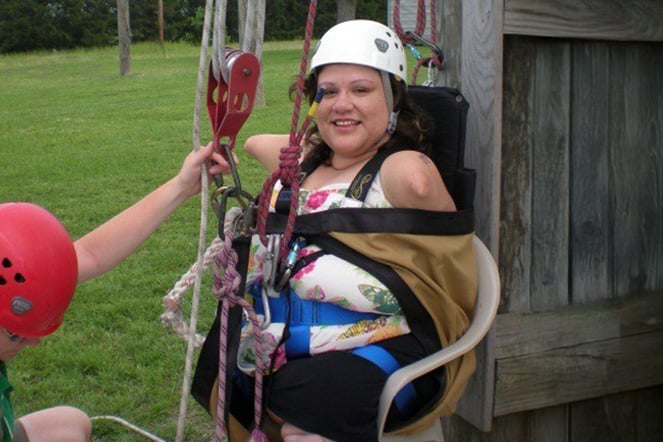
Ana prepares to use the new ropes course at Camp For All.
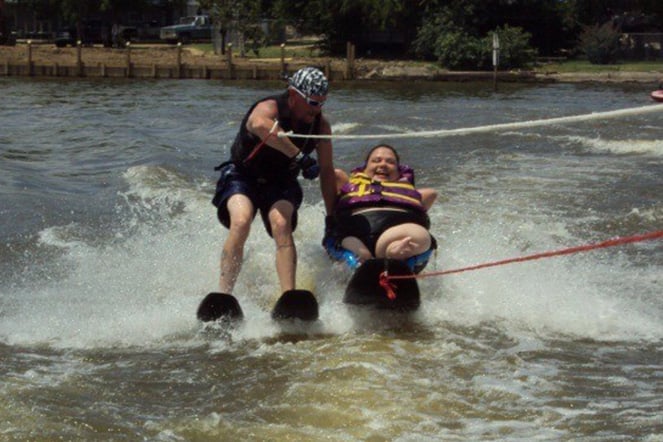
Ana learns how to waterski on a lake.
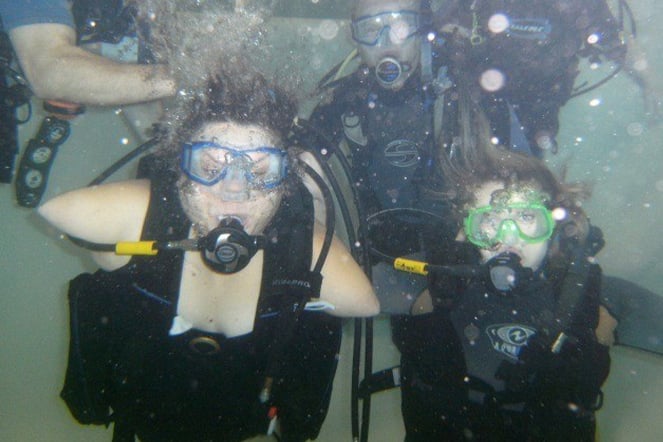
Ana takes part in a group scuba dive.
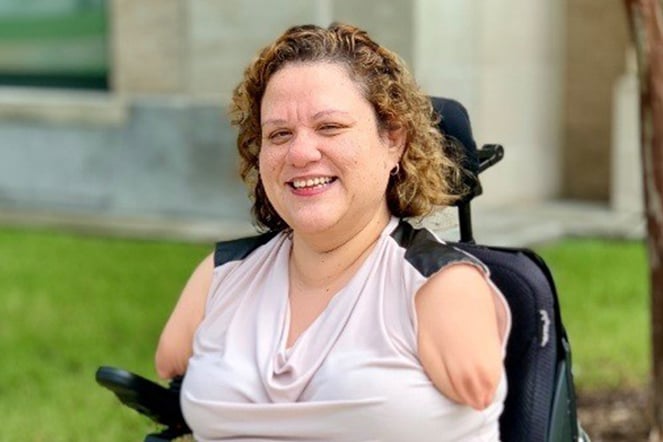
Ana enjoys the outdoors.
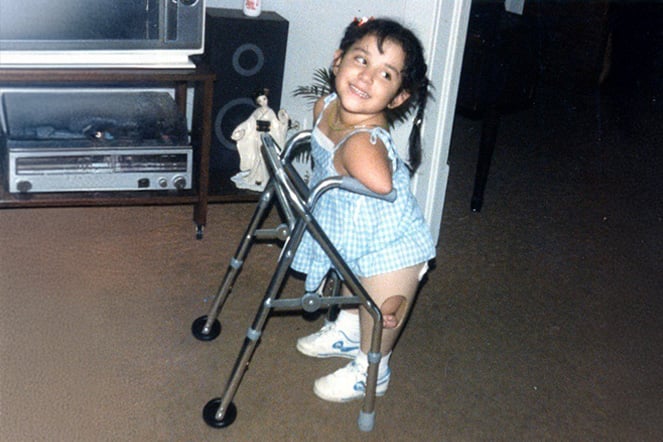
Young Ana stands with her walker.

Meet Ana.
At the time, prenatal technology was limited, so Ana’s parents were unaware of her disability before birth. Sitting in an El Salvador hospital, the doctors and nurses did not offer them much hope.
“People kept telling my parents she’s not going to live,” Ana said. “First it was a week, then two weeks. They kept saying I wasn’t going to make it.”
But Ana kept growing. She met her baby milestones. Her parents, who wanted nothing more than a full life for their daughter, began to look beyond the medical care available in their home country. Ana’s grandfather, a Mason, helped connect the family to Shriners Children’s. Her parents began researching the healthcare system and eventually submitted paperwork to ask whether one of the hospitals might accept Ana as a patient. Shriners Children’s Texas agreed to evaluate her.
Ana’s parents were only 26 years old when they decided to leave their home behind. They sold everything they owned, including their business, and traveled to Houston in search of a better future for their daughter.
“Shriners Children’s became another family for us,” Ana said. “The doctor told my parents she’s as normal as she can get; she’s only missing her limbs. She will be as disabled as you allow her to be.”
That advice became a guiding philosophy for Ana’s childhood. Her parents encouraged her to try things on her own and to challenge herself. Growing up, much of her time outside of school was spent at Shriners Children’s Texas, attending therapy sessions. Summers and late afternoons were dedicated to learning activities of daily living. Therapists worked with her on activities such as feeding herself, writing and learning how to complete everyday tasks independently.
“They wanted to make sure that if one day my mom or my father couldn’t do something for me anymore, I could still do it for myself,” Ana said.
Between the ages of 5 and 12, Ana began wearing prosthetic devices. Over time, however, she realized they were not the right solution. The devices felt unnatural to her. Ana preferred to interact with objects directly.
“I didn’t like the prosthetic devices,” she said. “It didn’t feel like me. I’m very tactile. I like to touch things and hold things.”
Instead, Ana developed her own methods. Today, she writes and picks up objects using her cheek and upper arm, gripping items like pencils, utensils and paper between them. She credits her increased independence to the team that supported her family in learning how to raise a child with a disability.
Shriners Children’s Texas was a godsend. They do amazing work.
“The staff took their time to teach my parents how to encourage me,” Ana said. “How to be a parent to a child who is different. They always told me, try. At least try it once. Then you don’t have the what-ifs in life.”
That mindset led Ana to try a little bit of everything. Over the years, she has participated in a variety of adaptive sports and activities, including adaptive water skiing, adaptive soccer and even bungee jumping. She’s attended Camp For All in Texas, a barrier-free camp where staff worked with her to create a specialized harness so she could safely bungee jump.
“I’m kind of a thrill-seeker,” Ana said with a laugh.
Ana’s adventurous spirit has taken her around the world. One of her favorite destinations is Bonaire, a Caribbean island known for its diving. Thanks to a connection at Shriners Children’s Chicago, Ana is officially scuba-certified. She said the sport is one of the most exhilarating yet calm things anyone could try.
Ana’s experiences with Shriners Children’s shaped her childhood and hobbies, but they also helped guide her professional path.
As a college student studying social sciences, Ana completed an internship at Shriners Children’s Texas during her undergraduate years. She assisted staff in therapy departments and supported receptionists with office tasks, honored to work alongside those who had once cared for her as a patient. After earning her Master of Social Work, Ana returned to the hospital full-time as a transition coordinator. She spent seven years supporting teenage patients as they prepared to move into adulthood, helping families navigate topics such as insurance, independent living and self-advocacy. Ana also organized transition camps, where teens could practice independence in a supportive environment.
“We did things like teaching them how to use public transportation, talking about college, learning how to make their own appointments and manage their medications,” she said. “I helped them understand how to advocate for themselves and prepare for life beyond pediatric care.”
Ana continued building an impressive career in advocacy and service. After leaving Shriners Children's, she spent 13 years at Houston Community College, running a program that helped students on the autism spectrum gain certifications and employment skills. Today, she serves as associate director for care services at the ALS Association in Texas.
Looking back, Ana sometimes finds it difficult to identify a single accomplishment that stands out. “I guess I take some things for granted because I just do them,” she said. “Being able to have a career, being able to drive my car. Just living life.”
In 2009, Ana achieved another milestone when she was crowned Ms. Wheelchair Texas. In that role, she traveled throughout the state speaking about the importance of education and empowerment. Throughout her journey, Ana never lost sight of the foundation that Shriners Children’s Texas gave her.
“Shriners Children’s Texas was a godsend,” Ana said. “They do amazing work. Part of my success was because of them, and I’m very thankful for their care.”

Ana learns how to waterski on a lake.
Ana takes part in a group scuba dive.


