


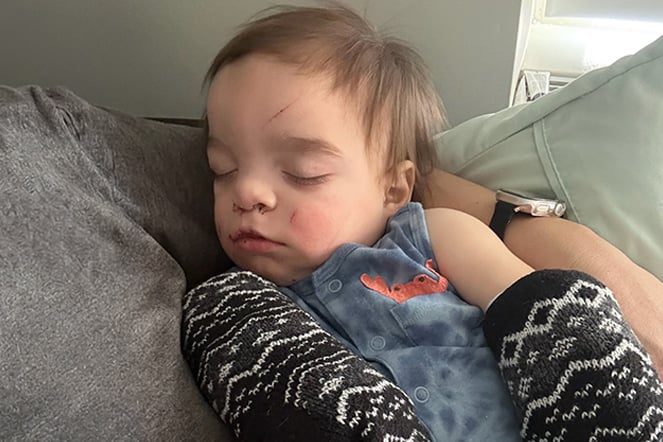
A peaceful Wesley takes a nap.
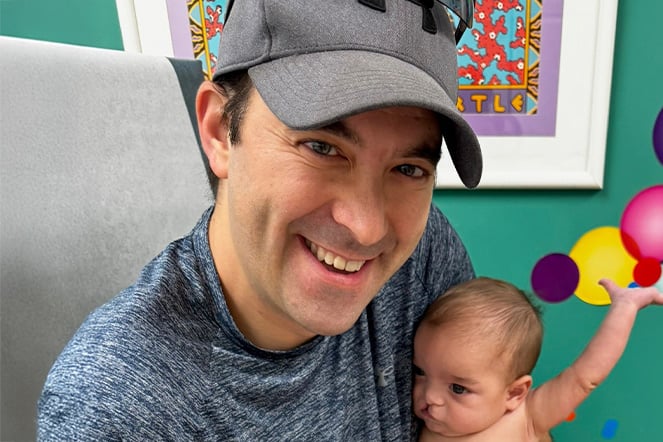
Wesley enjoys some quality time with his dad, Andrew.
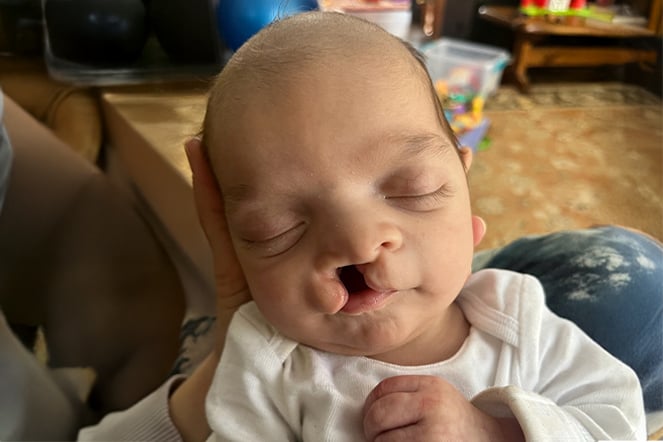
Wesley sleeps in a loved one's arms before his first surgery.

Eileen recalled how unexpected the news felt because a standard prenatal genetic screening had not identified this craniofacial condition.
Eileen and Andrew consulted with a genetic counselor who referred the family to Shriners Children’s Boston.
Wesley celebrated his first birthday at the end of December and is thriving after having his lip and palate repaired. He will be followed throughout his childhood by Kavitha Ranganathan, M.D., co-director of the Shriners Children’s Boston Cleft and Craniofacial Center, a collaborative program with Mass General Brigham for Children. “Dr. Ranganathan’s surgical attention to detail is unbelievable,” said Eileen. “She is one of the warmest and caring individuals I've ever met in the medical field. We have been so grateful for her expertise and bedside manner."
Wesley has had two surgeries at Shriners Children’s Boston, one to repair his cleft lip and another to repair his palate six months later. Dr. Ranganathan explained why it is important to do the cleft lip surgery first. “When we close the lip, that narrows the cleft in the palate a little. Another reason we address the cleft palate after the lip surgery is because we want the upper jaw to grow as much as possible without missing the window before the child starts developing speech. We want to do the palate repair before that,” she said.
Wesley is now returning for periodic follow-up appointments, in part to assess how his teeth are developing. Dr. Ranganathan anticipates performing Wesley’s next surgery when he is between 7-9 years old and expects that additional future surgeries will include a bone graft and rhinoplasty.
Dr. Ranganathan noted that those specific surgeries are timed after the initial set of repairs, to give a child’s face time to develop. “For the bone graft surgery, we want the face to be at a point where a child’s permanent teeth are coming in. For the rhinoplasty, we want a child’s face to be mostly done growing, so whatever reconstruction might be needed for the nose is a more permanent result for that child going into adulthood,” she said.
“Dr. Ranganathan's commitment to her patients has made this journey so positive, and she has talked us through several scary moments as parents. The fact that she will follow Wesley through his 18th birthday is so special,” Eileen said.
Dr. Ranganathan's commitment to her patients has made this journey so positive, and she has talked us through several scary moments as parents. The fact that she will follow Wesley through his 18th birthday is so special.
Eileen and Andrew are new members of the Craniofacial Patient Family Advisory Council (PFAC), which is led by nurse care manager Sandy Barrett, BSN, RN, CCM. Sandy was one of the first people the family connected with at Shriners Children’s Boston and has remained a steady presence throughout their journey.
“Networking with other parents of children with cleft diagnoses has been invaluable. It's also been very evident that Shriners Children’s cares about patients' and families' experience at the hospital, and some of the feedback that we've given has already been implemented and researched for future implementation,” Eileen said.
Sandy explained that the PFAC at Shriners Children’s Boston had traditionally drawn more patients and families receiving burn care or reconstructive treatment. In recent years, the number of patients coming to the hospital for craniofacial care has grown. “Establishing a separate craniofacial PFAC really came through families requesting it. At our last meeting, one parent was talking about mouth guards, and another parent with an older child shared her family’s experience with them. This is a way to provide support and education for our craniofacial families who are at different phases of care, and give them an opportunity to connect with each other,” she said.
More than a year after Eileen and Andrew learned Wesley would be born with a cleft lip and palate, they have some perspective for other parents just absorbing a craniofacial diagnosis. “This diagnosis is so overwhelming at the beginning,” Eileen said. “I encourage parents to give themself lots of grace and take time to 'feel the feelings' together. There were many, many difficult moments that we experienced while we grappled with this news.”
Eileen describes Wesley as a happy baby who “is constantly on the go, exploring and playing with everything he can get his hands (and mouth!) on.” Since Wesley’s cleft palate repair, he has been introduced to a variety of new solid foods, and he loves experimenting with different flavors and textures.
Wesley also enjoys chasing after his older sister, 3-year-old Ellie, determined to do everything she does. Eileen said that Wesley and Ellie “are in a weekly playgroup together, and he's fascinated by watching other kids move and play. His sense of humor is developing, and he loves to laugh!”
"Putting Wesley's care in Shriners Children’s hands was the best decision. It's a blessing that we know all his treatments will be provided in one place until he is an adult," said Eileen. "As he gets older and can start to make some medical decisions for himself, I know the doctors and staff will help to guide him through his concerns just as they are with us.”

A peaceful Wesley takes a nap.
Wesley sleeps in a loved one's arms before his first surgery.


