


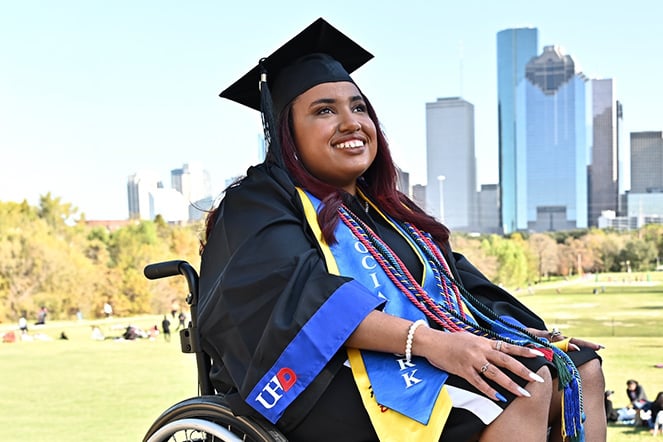
Breanna celebrates her graduation with a photoshoot in downtown Houston.

Breanna shows off her class of 2021 pendant.
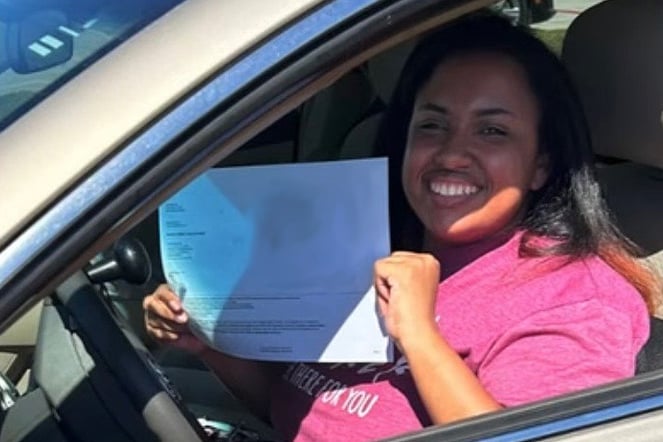
Breanna displays her driver's license.
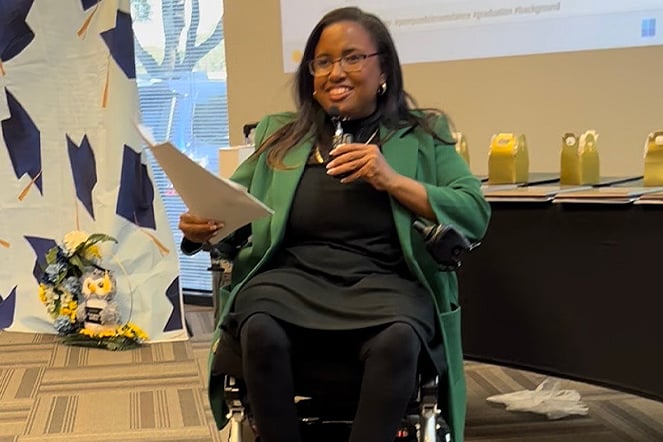
Breanna speaks at an event.
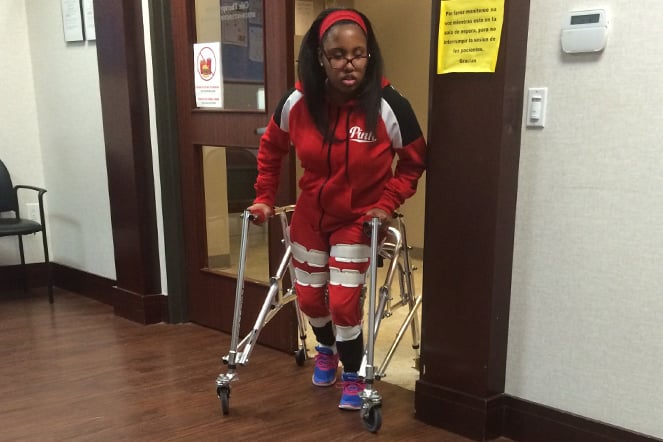
Breanna uses her walker.

When Breanna looks back on her childhood, some of her most meaningful memories come from the three years she spent at Shriners Children’s. Born with spastic diplegia cerebral palsy, a condition that affects muscle control in the lower limbs, Breanna’s future and level of independence were uncertain. Her early childhood involved hospital visits, braces, therapy sessions and, eventually, surgery. Now 26, she carries a deep appreciation for the care and support she received during that time in her life.
Breanna became a patient at Shriners Children’s in 2008 when she was 9. She credits the staff at Shriners Children’s for guiding her through a crucial part of her care. “They specialized in my surgery and had everything else I needed,” she said.
Breanna’s treatment plan included hamstring-lengthening surgery, ankle plates to help with stability and movement, physical and occupational therapy, and orthotic bracing. Breanna recalled the doctors who managed her care, including her orthopedic surgeon, William Phillips, M.D., who played a hands-on role in ensuring she was comfortable and progressing well. He visited her hospital room regularly and monitored her recovery through sessions in the motion analysis center, a space where her walking patterns were tracked to fine-tune her treatment.
The hospital therapists also worked closely with Breanna. She received custom orthopedic devices, including knee-ankle-foot orthoses and ankle-foot orthoses, to help her walk more comfortably. While she eventually transitioned her care to other facilities as she grew older, she remembers those early years at Shriners Children’s as both formative and supportive.
“They had game nights and movie nights, just to make the stay a little bit more home-like for the patients,” she said. Breanna made friends with other children going through physical therapy and recalled a strong sense of community within the hospital.
“I think back to my time at Shriners, and I never really felt like a patient. I felt like I was part of a family,” she said. “They were there to support me, to encourage me.”
Shriners Children’s is a starting place, and it’s a gateway to all of what's possible. It holds so much promise.
Breanna also enjoyed attending school at the hospital.
“I received one-on-one instruction. I would even say it was better than my actual schooling sometimes,” she said with a laugh. Breanna had homework every day, and although that might not sound like fun to most kids, she looked forward to it. The daily routine gave her a sense of normalcy and helped her stay on track academically.
After graduating from high school, Breanna attended the University of Houston Downtown, where she earned her undergraduate degree in social work. Today, she works with students with disabilities to help them gain accommodations in their classrooms. According to Breanna, it is a full-circle moment.
“I think my condition has given me purpose to help people in the same walk of life as me,” she said. “I’m naturally a helpful person. I think that’s why I gravitated towards this profession. To me, the most important thing is to advocate and educate others so that we have a place in the world.”
Breanna hopes to earn her master’s in social work and influence policies that support and protect people with disabilities. She has come a long way from her days as a patient at Shriners Children’s, but she credits those years with giving her the independence she has now.
“Shriners Children’s is a starting place, and it’s a gateway to all of what's possible,” Breanna said. “It holds so much promise. Shriners is home for a lot of people. It’s a place of belonging and what’s possible – and they’re breaking barriers.”

Breanna celebrates her graduation with a photoshoot in downtown Houston.
Breanna shows off her class of 2021 pendant.
Breanna displays her driver's license.
Breanna speaks at an event.
Breanna uses her walker.


