


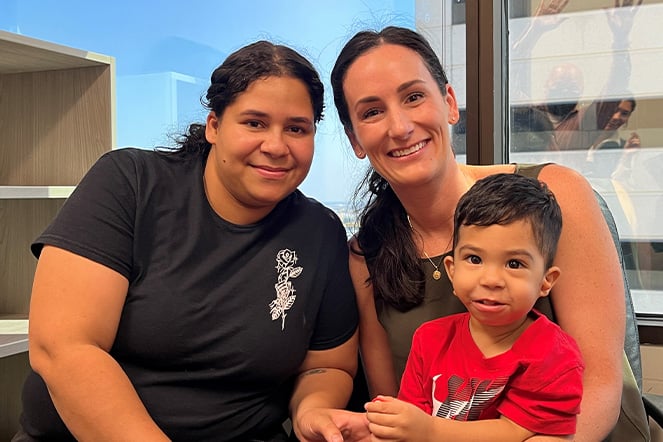
Josuad smiles with his mother, Mercy (left), and Lauren Aguilarte (right), the Med-el clinical account manager.
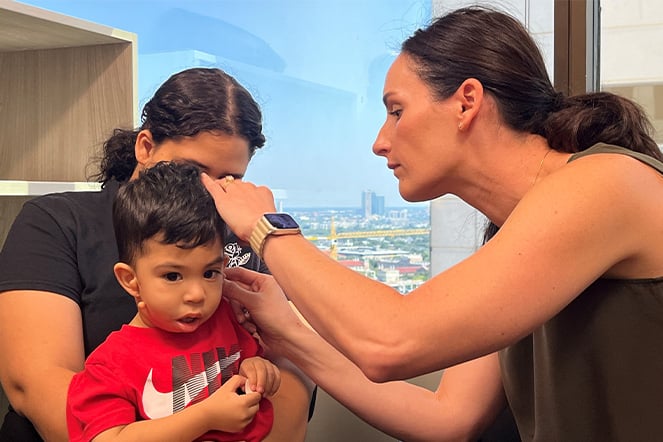
Lauren places the ADHEAR device behind Josuad's left ear.
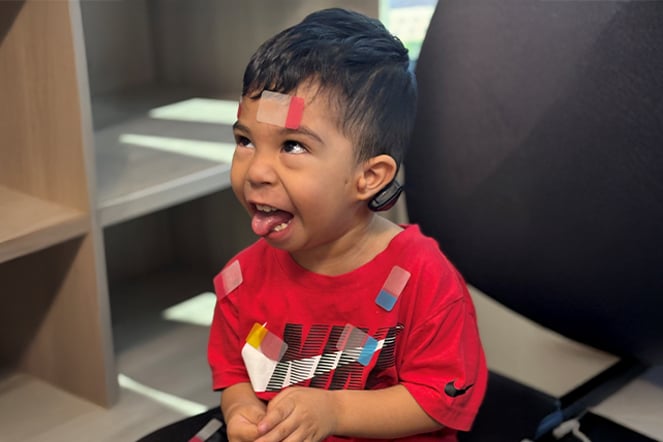
Josuad remains playful with his new hearing device on.


Meet Josuad.
Earlier this month, he sat patiently on his mother’s lap as a hearing aid was placed on him. Josuad’s eyes lit up as he heard his mother’s voice for the very first time.
Josuad was born with a rare horizontal cleft at the corner of his mouth, as well as extra skin and cartilage around his underdeveloped ears, which lacked a fully formed ear canal. These conditions created major barriers to his hearing and speech. Now, with his new device, Josuad finally has the chance to connect with the sounds around him. It has opened the door to a world of possibility.
“One of the things we take for granted is our hearing for our speech. Those things are interconnected completely,” said Phileemon Eric Payne, M.D., a pediatric plastic surgeon and craniofacial specialist at Shriners Children’s Texas.
“If you’ve ever heard somebody who’s deaf, they sound like they just don’t know how to talk right, and it’s because they can’t hear the sound of their own voice a lot of times," said Dr. Payne. "And they don’t have that neural development to say, okay, this is the feedback. I can hear my voice, I can hear how I sound, I can hear the things that I’m saying, and that helps them communicate. So, if their hearing is bad, then their speech doesn’t work well.”
Dr. Payne emphasized that the earlier children begin to hear clearly, the more it shapes their ability to speak and learn. Early intervention is crucial to support the neural development process.
The device Josuad now wears is called ADHEAR, developed by Med-el, a company specializing in hearing implants and devices. Instead of requiring surgery or an uncomfortable headband, ADHEAR just uses a small adhesive adapter placed behind the ear.
Lauren Aguilarte, AuD, CCC-A, a Med-el clinical account manager, placed the device on Josuad and explained how it works: “It’s bone conduction, so it’s a vibration of the temporal bone. And the cochlea, which is a snail-shaped organ that sits within the bone, is stimulated and moves the hair cells that allow us to hear. So, it’s just a different way to transmit sound.”
ADHEAR also requires very little maintenance compared to other devices. “It doesn’t require a lot of aftercare,” Aguilarte said. “And it’s one size fits all. As a child grows, it will become less noticeable.”
One of the things we take for granted is our hearing for our speech. Those things are interconnected completely.
The hearing aid was made possible through funding from the Masonic Children & Family Services of Texas, covering the costs that Mercy, Josuad’s mom, could not afford. “My experience with Shriners has been very, very good,” Mercy said. “It’s a great team here, and they are a big help for us. I heard about Shriners Children’s when I went to a clinic. Right now, I don’t have the money for the hearing aid. But Rachel tried her best to find a way to get this done.”
Rachel Hogan, M.A., CCC-SLP, is a speech-language pathologist and the cleft lip and palate team coordinator at Shriners Children’s Texas. She worked closely with Mercy to coordinate the appointment and ensure the device could be secured for Josuad.
At home, Josuad is an active, playful toddler who loves to scribble and draw with paper and pencils, switching between his right and left hand. His favorite toys include dinosaurs and cars. Josuad also enjoys entertaining his younger sister. When it comes to food, Mercy laughs that he is not picky. “He likes to eat everything.”
With his new hearing aid, Josuad now has the tools he needs to grow and explore in ways he never could before. His care team at Shriners Children’s Texas encourages him to wear the device as much as possible, and they look forward to seeing all the progress he will make. As for Mercy, the tears in her eyes said everything. Her son could finally hear her voice.

Josuad smiles with his mother, Mercy (left), and Lauren Aguilarte (right), the Med-el clinical account manager.
Lauren places the ADHEAR device behind Josuad's left ear.
Josuad remains playful with his new hearing device on.


