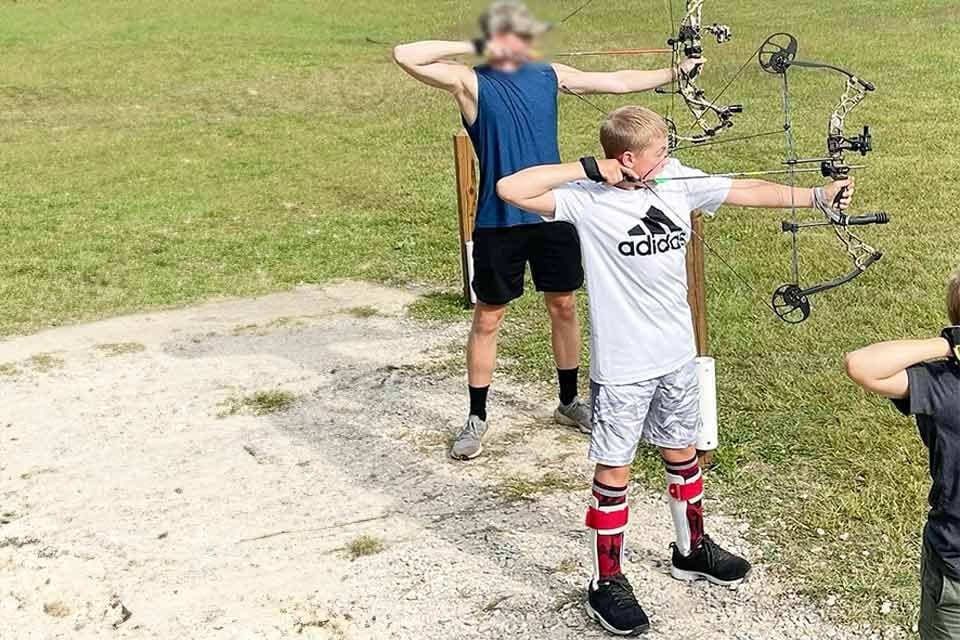
Liam’s favorite subject in school is science.
The bright and smiley 14-year-old said he loves the idea that, “you can combine different elements and create a new one.” Born with a rare genetic disorder, Liam’s progress in life has required the perfect combination of necessary elements to help him be successful too. His mom, Melissa, said one of those elements was finding Shriners Children’s.
Looking for Answers
From the time he was an infant, Liam’s parents noticed physical differences, especially around the time he started to walk. “He would fall every five minutes or so,” Melissa said. “The disorder robs him of his balance. His muscles are very stiff, so he couldn’t move his legs correctly. He began toe-walking. He wasn’t able to dress himself because of his limited mobility.”
It wasn’t until Liam was 5 when his parents were able to get answers about his condition. They took him to Shriners Children’s Boston, which specializes in burn care. Although the hospital could not treat Liam’s condition, they were able to help make connections for his care at Massachusetts General Hospital in Boston.
“The team at Shriners in Boston sent Liam to Mass Gen to see an orthopedic doctor,” Melissa said. “They saw Liam’s symptoms, but weren’t sure what was causing it. We were able to work with a panel of 12 neurologists and get genetic testing.”
The testing uncovered that Liam has KIF1A associated neurological disorder (KIF1A), a rare neurodevelopmental and neurodegenerative disease caused by mutations in the KIF1A gene. Symptoms of KIF1A often appear at birth or in early childhood, but the rarity of the disorder makes diagnosis difficult.
What is KIF1A?
KIF1A is so rare that there are only about 550 confirmed cases in the world, and of those cases, there are more than 100 different mutations of the gene. As of now, Liam is the only person in the world identified with the type of mutation he has. Because of the various mutations, KIF1A affects each person differently. For Liam, the disorder causes stiffness and atrophy of his muscles. He deals with some cognitive impairment and is monitored for atrophy of his optic nerves.