A Family's Healing
Because the sisters’ mom, dad and grandfather were recovering from their own burns, their only visitor was their grandmother. Still, Amy said she was emotionally shutting down. It was a phone call and some tough love that changed her response.
“I think it was about three weeks I had been there when I got to talk to my mom on the phone,” she said. “It made a big difference. My grandmother said she saw tears coming out of the corner of my eye.”
But Amy said it was her grandmother’s tough love that set the course for how the entire family would handle their recovery. “She always said we don’t have time to feel sorry for ourselves,” Amy recalled. “We had to get up, get going and do what needed to be done.” Amy recalls a nurse who had that same mentality. “At the time she seemed really mean to me, but looking back, forcing me to do the stretches, changing my bandages, is what helped save my life,” Amy said.
After two months, Lacy was released from the hospital; then a month later it was Amy’s turn to go home. However, in many ways, the sisters say their time after the hospital was actually the most difficult.
“We don’t know how our parents did it,” Lacy said. “They were still recovering from their own painful burns and now they had to take care of three kids who had their own injuries.”
It’s no surprise their recovery took a village. Lacy and Amy said neighbors would often come over to help them with water therapy and stretching. Their brother Peter turned into their personal protector, playmate and confidant. “I was wrapped up in these bandages, still in a lot of pain, and these kids would run up to me and Peter would run ahead and put his arms out to stop them from touching my skin,” Amy said.
Still, Amy and Lacy called growing up with their scars “punishing.” “Kids would tease us of course and, as I got older, people asked how I could walk around with a scar on my face,” Lacy said. No matter how cruel kids were to the sisters, their mom was always there for support and a reality check. “She would say ‘Nobody is special in this family. We’re a unit and we’ll get through this together,’” Amy remembered.
Survivors’ Perspective
Now, 50 years after that accident, the sisters have a better perspective of their experience. “No question the Shriners [Hospital] saved our lives,” Lacy said. “We wouldn’t be here today without the care.”
As for the scars, the sisters, who are now mothers, said they have accepted, and in some cases celebrated, the permanent reminders of what happened. “I wear a scar on my face because it could have been so much worse,” Lacy explained. “My dad literally went through fire to save me and this scar from his belt buckle is a badge of love.” “I stopped caring when people stared at me because I developed self-confidence,” Amy said. “We were raised not to have a victim mentality and that’s what I taught my kids.”
The sisters are now in a position to give back to Shriners Children’s Ohio – the new name and new location of the hospital that saved their lives.
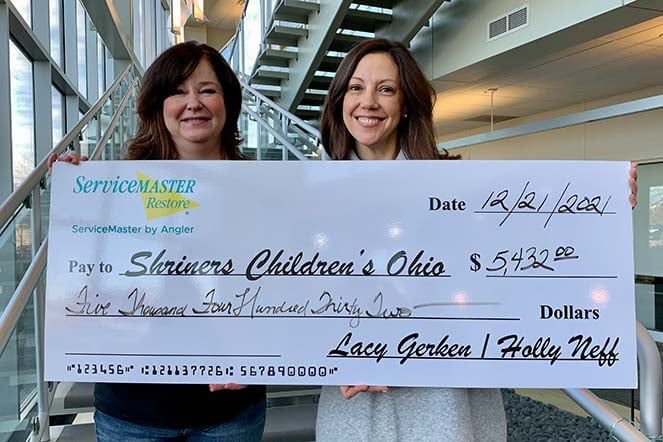
Lacy and her husband are co-owners of a fire restoration business. Lacy said the irony is obvious. “We had been looking for an organization to support and when we heard Shriners Children's moved to Dayton, it hit us like a ton of a bricks,” Lacy said. “We have a fire business and I’m a fire survivor.”
Amy works at a pottery company, located just three miles away from the hospital where she was treated, and is developing a custom ornament with a portion of the proceeds benefitting the hospital. Amy calls it a “full circle moment.”
“Everything is just sort of coming together. The accident was on the Ohio River and that put us close enough to Cincinnati and in the halo of Shriners.”
Amy and Lacy are excited to be early members of the Patient Alumni Network. The Patient Alumni Network was formed in 2022 as part of Shriners Children's 100th Anniversary Celebration. The goal of this new network is to connect former patients with each other and provide opportunities for them to share their stories and accomplishments with other patients, Shriners, donors and the public.