


Ultrasound Service at Shriners Children’s Lexington Helps Detect Hip Dysplasia in Infants Sooner
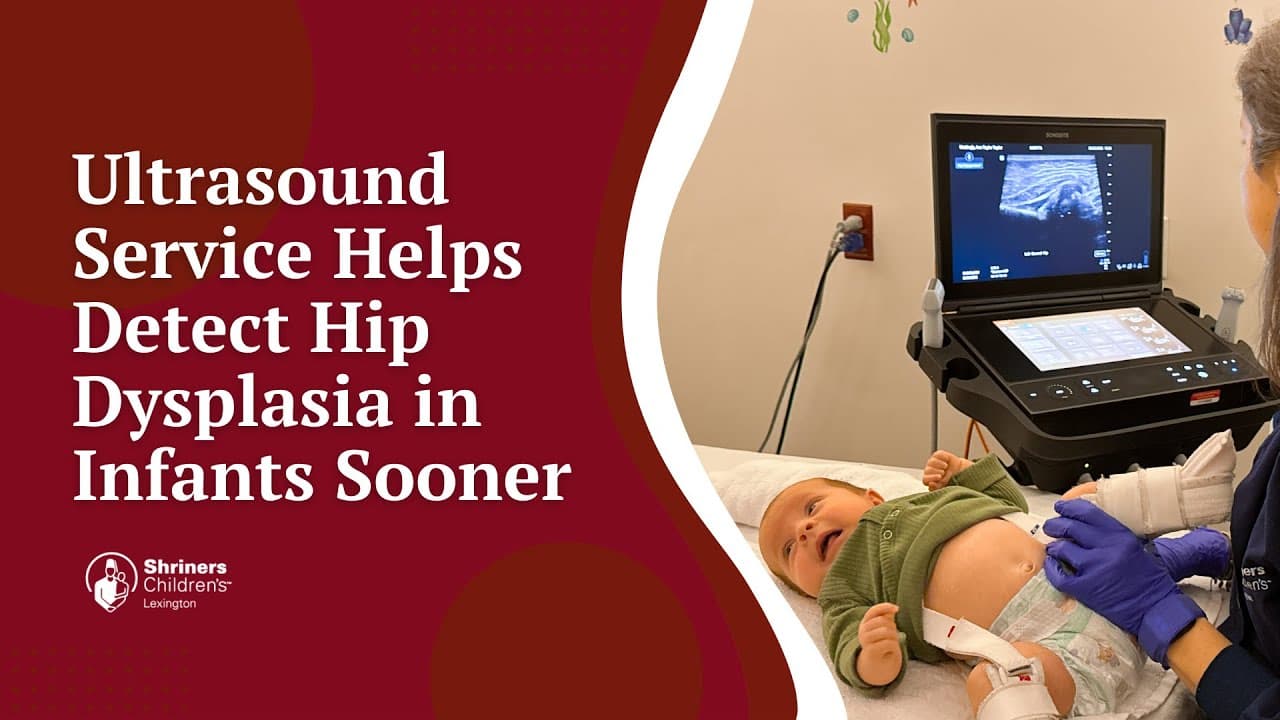
Shriners Children’s Lexington has expanded its diagnostic services to include hip ultrasounds for babies under 6 months old, offering families peace of mind – and early answers – all in one place.
Expanding Access to Early Diagnosis
Sarah Welch, a radiologic technologist at Shriners Children’s Lexington, has been performing ultrasounds to assist with scoliosis care and ganglion cyst diagnoses.
Starting in November 2024, Sarah and the radiology team began offering hip ultrasounds for infants who may be at risk for developmental dysplasia of the hip (DDH), a condition where the hip joint doesn’t form properly in early life.
“We’ve been doing ultrasounds for MAGEC spinal rods and cysts for a while,” Sarah said. “We just recently added the hip dysplasia ultrasound.”
DDH often affects babies who were breech in utero, first-born females, have a family history of the condition or have low fluid levels during pregnancy.
“They don’t know exactly why those specific conditions are risk factors for hip dysplasia, but our physicians keep an eye on children who fall into those categories,” Sarah said.
Why Ultrasounds?
While X-rays are helpful for many orthopedic needs, they don’t always give clear insight into the cartilage of a newborn’s hips.
“When a child is under the age of 6 to 8 months old, their bones have not hardened enough or ossified to make them visible on X-rays,” Sarah said. “Ultrasounds can visualize the cartilage before it turns bony. Then we can confirm if the child has hip dysplasia or not.”
To bring this service to Lexington, Sarah traveled to Texas to train with the team at Scottish Rite for Children, a fellow pediatric orthopedic center of excellence.
“That allowed us to start performing ultrasounds in November of 2024,” she said. “It’s an excellent opportunity for our families to receive care in one location. Before we started doing ultrasounds here, we had to refer the family to an outside facility.”

Sarah Welch, a radiologic technologist at Shriners Children’s Lexington, performs an ultrasound on Ann Taylor, a patient diagnosed with developmental dysplasia of the hip.
A Cozy, Comforting Space for Families
Now, families can check in at the front desk, follow the same traffic pattern as other imaging patients, and head directly to the newly-designed ultrasound room. The new room was created to be a calming, comforting space for both babies and caregivers.
“We were able to decorate it in a way that we felt was kind of cozy and calming to both the parents and the patient. The mobile hanging from the ceiling really helps distract the babies when they’re lying on the bed. It also plays music, so that gives them a little distraction, too. Several parents have commented about how it feels calming in here, and I think that helps everybody – the baby, the parents, me, everyone involved.”
The team also makes thoughtful adjustments to help babies feel at ease during the scan. “I try to have a warm towel for the baby to lie on so that they can be even cozier,” Sarah added.
What to Expect During the Ultrasound
During the ultrasound, Sarah scans the right hip, carefully wipes away the gel and adjusts the diaper to minimize discomfort. Then she moves on to the left hip.
“The scans don’t hurt the baby at all, but sometimes they’re a little grumpy because they have to lie on their back and not be held by mom or dad,” she said. “Anything we can do to make it more comfortable and more calming for the child will help us have a quicker scan and also help me get better pictures for the physicians to diagnose exactly what’s going on with the child.”
Sarah has completed over 150 hip ultrasound exams since November. Some families return for follow-up scans to monitor progress or determine whether their child is ready to reduce harness usage, if treatment is necessary.
“If we find something on their ultrasound, the physician will put them into what’s called a Pavlik harness, which looks like little overalls that they wear, and that holds their legs spread apart, while also guiding their legs back into their pelvis, which helps the joints form better as they grow,” Sarah said.
Why Early Detection Matters
Diagnosing and treating hip dysplasia early is critical. “It is much easier and less invasive to treat when a patient is under 6 months old.”
Waiting can lead to more complex treatment, such as firmer braces, surgery and/or a spica cast. Those can be difficult to manage for children and caregivers.
“We encourage parents to watch for signs, like a noticeable hip 'click' during diaper changes or any clunky movement in the hip area.” If something feels off or if there are known risk factors, parents should talk to their pediatrician about a referral to Shriners Children’s Lexington.
If your child has risk factors for hip dysplasia or your pediatrician recommends further evaluation, you can request an appointment by calling Shriners Children’s Lexington or submitting an online appointment request. No referral is needed, and new patients are always welcome.
Early diagnosis can mean easier treatment and a healthier, more confident start for your child.
“While it’s scary for the parent, if hip dysplasia is handled early, it can typically be resolved and not a big deal,” Sarah said. “They wear this cute little harness for a little while, and then they’re all good to go.”
Support, Comfort and Compassionate Care
Bringing a new life into the world is a joyful experience, but it can also come with uncertainty, especially when questions about your baby’s development arise. At Shriners Children’s, families can trust that compassionate, specialized care is close to home.
“I’m sure as a parent, having a brand-new baby and hearing that something may not be perfect can be very concerning and scary, even,” Sarah said. “And I would hope that parents know that everybody at Shriners … our only goal is to make sure that the child has all the care that they need.”


Keep In Touch
Join our mailing list to stay up to date on everything that's happening at Shriners Children's.
Next Steps
Share Your Story

Give to Shriners Children's

