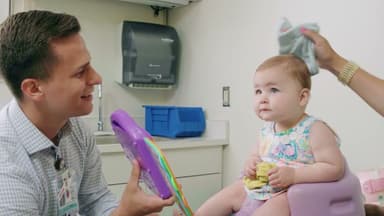
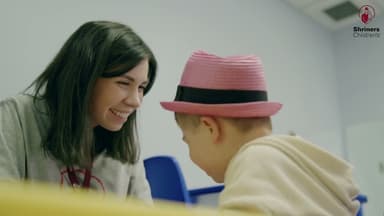
prosthetics provider in workshop with male orthotics patient

Pediatric Orthotic and Prosthetic Services (POPS) at Shriners Children's Erie

POPS is the Region's Only Orthotic and Prosthetic Program Dedicated Exclusively to Children

A visit to Pediatric Orthotic and Prosthetic Services (POPS) at Shriners Children's Erie is more than measurements and mechanics. POPS is the region's only orthotic and prosthetic program dedicated exclusively to children. Our certified orthotic and prosthetic practitioners are trained in the specialty needs of infants, children and adolescents. They understand the unique requirements of growing bodies and how those needs change and evolve as children get older.

Our POPS providers support children of all ages and abilities through skilled evaluation, design, customization, fitting and management of a wide range of orthotic and prosthetic devices. Our team provides solutions to restore movement and independence, correct and realign deformities, support and strengthen weakened limbs, and protect orthopedic injuries, allowing children to meet their full potential and pursue their dreams.

I enjoy my appointments at POPS because I feel safe. They educate me about scoliosis, comfort my fears and make me feel confident and proud to wear my brace.
Savannah, Shriners Children's Erie patient

Custom Orthotic Devices

  • Foot Orthotics
  • Supramalleolar Orthoses (SMOs)
  • Ankle Foot Orthoses (AFOs)
  • Knee Ankle Foot Orthoses (KAFOs)
  • Hip Knee Ankle Foot Orthoses (HKAFOs)
  • Scoliosis TLSOs
  • Cranial Remolding Orthoses
female wearing brace

Off-the-Shelf Bracing

  • Walking boots, ankle supports and knee supports
  • Hip bracing
  • Wrist hand, elbow and shoulder supports
closeup of wrist brace

Custom Lower Extremity Prosthetic Solutions

  • Lower Extremity Prostheses
    • Partial foot
    • Symes
    • Transtibial (below knee)
    • Knee disarticulation
    • Transfemoral (above knee)
    • Hip disarticulation
    • Hemipelvectomy
patient wears leg prosthesis during physical therapy

Custom Upper Extremity Prosthetic Solutions

  • Upper Extremity Prostheses
    • Partial hand
    • Wrist disarticulation
    • Transradial (below elbow)
    • Transhumeral (above elbow)
    • Shoulder disarticulation
male patient displaying thank-you artwork
Alex Betancourt headshot
Alexander Betancourt, MS, MBA, CPO
Alex Betancourt headshot
Alexander Betancourt, MS, MBA, CPO

Alexander Betancourt, MS, MBA, CPO, is a certified prosthetist orthotist with more than a decade of experience specializing in pediatric orthotics and prosthetics. He currently serves as manager of Pediatric Orthotic and Prosthetic Services (POPS) at Shriners Children’s Erie, where he oversees clinical care, multidisciplinary integration and resident education. Alex received his Master of Science in Prosthetics and Orthotics from the University of Pittsburgh and later earned an MBA in healthcare management from Johns Hopkins University.

Alex’s professional interests include scoliosis management, cranial remolding orthoses, lower- and upper-limb prosthetic care, and general lower limb orthotic management. He is particularly passionate about establishing multidisciplinary clinic models, expanding access to high-quality orthotic and prosthetic care, and leveraging technology to improve function, mobility and independence for children. Alex serves on the American Academy of Orthotists & Prosthetists Hospital-Based O&P Practice Committee, the University of Pittsburgh MSPO Advisory Board, and the Medical Advisory Board for Project Perfect World, where he also participates in international outreach efforts.

Allison Palermo headshot
Allison Palermo, MSPO
Allison Palermo headshot
Allison Palermo, MSPO

Allison Palermo, MSPO, earned a bachelor’s degree in biomedical engineering with a minor in mathematics from the University of Akron, followed by a master’s degree in prosthetics and orthotics from the University of Pittsburgh, where she also served as president of her class. While enrolled in the Master of Science in Prosthetics and Orthotics program at the University of Pittsburgh, she completed an internship with the Pediatric Orthotic and Prosthetic Services (POPS) team at Shriners Children’s Erie. Allie completed a pediatric-focused residency in Pittsburgh at Union Orthotics and Prosthetics Co. Through her experiences, Allie developed a deep passion for working in pediatrics, inspired by the resilience of children and driven by a desire to help them reach their goals. She feels fortunate to now work in a multidisciplinary environment like Shriners Children’s Erie.

Outside of work, Allie enjoys spending time outdoors, especially boating, biking, kayaking and walking around beautiful Presque Isle State Park.
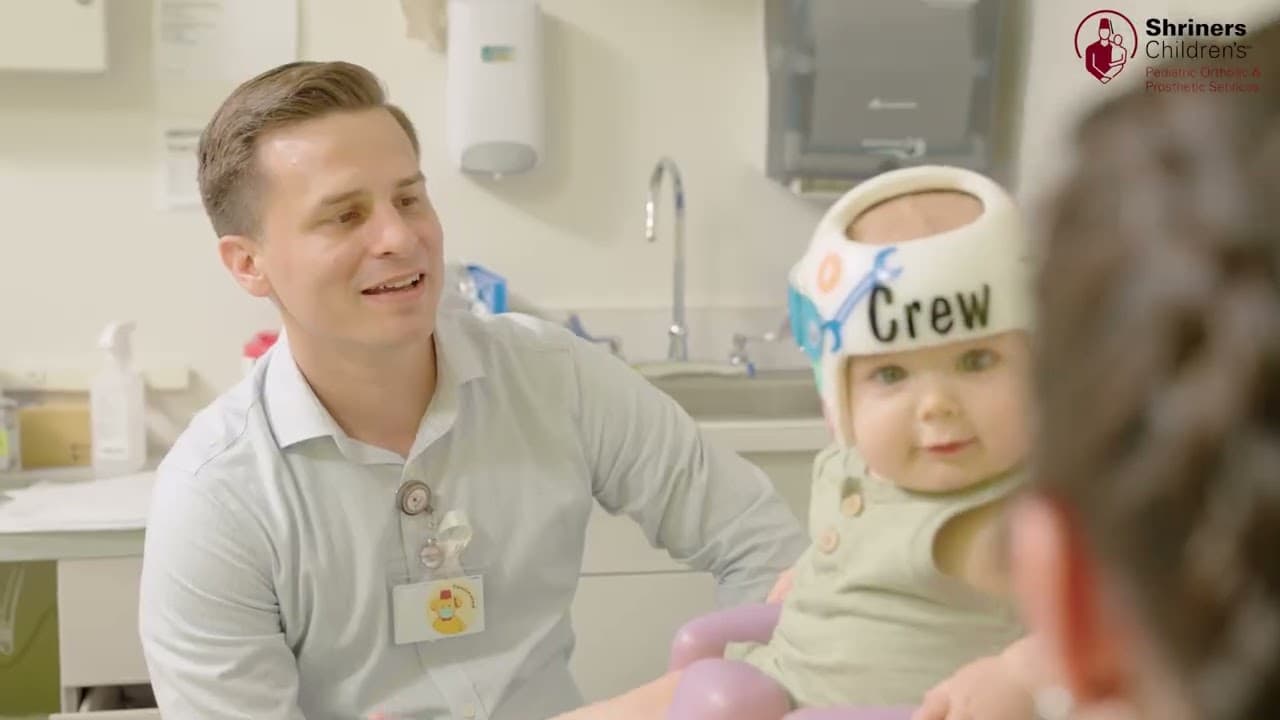
Custom Pediatric Orthotics and Prosthetics Fabrication for Shriners Children's

Custom Pediatric Orthotics and Prosthetics Fabrication for Shriners Children's

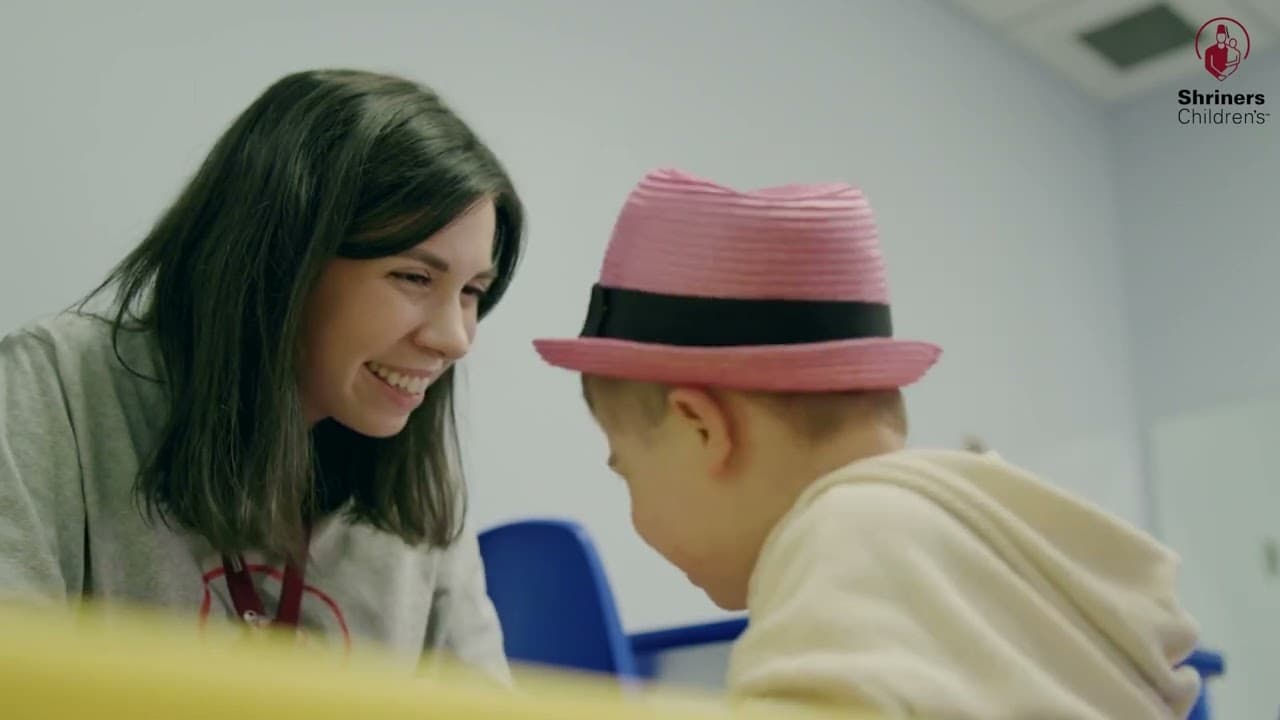
Pediatric Orthotic and Prosthetic Services (POPS) at Shriners Children’s includes teams of certified prosthetists, orthotists and specially trained technicians who manufacture and fit custom-designed braces and artificial limbs.
View Transcript

[Shriners Children’s Pediatric Orthotic and Prosthetic Services logo]

JoAnne Kanas, DPT, CPO, Corporate Director of Pediatric and Orthotic Prosthetic Services:

Welcome to POPS, also known as Pediatric Orthotic and Prosthetic Services. The mission of POPS, like Shriners Children's, is to provide the best orthotic and prosthetic care to all of our patients in every location throughout the US and around the world. Our care is provided regardless of a family's ability to pay. POPS is a separate LLC from Shriners Children's, yet it is solely owned and controlled by Shriners Children's.

Prior to the start of this program in 2014, each Shriners Children's location had their own orthotics and prosthetics program. Our new program ensures a consistent, high quality device for all of our patients. Our patients are seen in their local Shriners Children's location with the medical team and the POPS team. Depending on their medical needs, interests, hobbies and goals, the team determines which device each patient needs. Now, instead of having that device made locally, we utilize computer aided design and most of our devices for our patients are custom fabricated at two locations, one in Tampa and the other at Shriners Children's Portland.

Brad Mattear, LO, CPA, CFO, O&P Central Fabrication Program Manager:

Here at our fabrication center in Tampa, we produce custom devices for over 17 Shriners Children's locations. We oversee the digital CAD technology used to capture images of the children's extremities and torsos. All devices go through a rigorous quality assurance review prior to leaving our facility and returning to the prescribing hospital. This ensures all of the devices produced are completed in a timely manner and delivered to our locations across the country and the world to meet each child's clinical needs.

With CAD technology, our highly qualified practitioners are able to take a scan of the child's affected body part and do modifications to the shape while still in the room. They can modify a patient's scan to the millimeter and send that data electronically from anywhere across the country or the world to our facilities in Tampa or Portland. What used to take a couple of hours to complete, we can have modified and into production within 20 minutes.

JoAnne Kanas DPT, CPO, Corporate Director of Pediatric and Orthotic Prosthetic Services:

It's great that POPS has the ability to provide whatever orthotic and prosthetic is needed for each patient throughout our system. Shriners Children's strives to keep up with technology so that our patients can achieve their goals and dreams.

Brad Mattear, LO, CPA, CFO, O&P Central Fabrication Program Manager:

Everything that we do at POPS is individualized to the child. With the advancements and the components of prosthetics, we design legs for sprinting, swimming, playing instruments, whatever activity interests our patients. From weightlifting to playing the violin to competing in high-level sporting competitions, our amazing patients are meeting their goals with these specially adapted devices. We have all the tools and technology we need to meet our patient's special requests.

JoAnne Kanas DPT, CPO, Corporate Director of Pediatric and Orthotic Prosthetic Services:

This lab is truly state-of-the-art. It was designed to take into account safety, function and the most efficient workflow to ensure that this facility is one of the best throughout the country.

Brad Mattear, LO, CPA, CFO, O&P Central Fabrication Program Manager:

Once we receive the child's measurements digitally, we have the ability to have their devices completed in under 24 hours when there's an emergent need. There's a pride that Shriners Children's has always been on the forefront of technology in the pediatric orthotics and prosthetics industry.

JoAnne Kanas DPT, CPO, Corporate Director of Pediatric and Orthotic Prosthetic Services:

Our highly qualified POPS team members are solely focused on pediatrics. They understand the unique requirements of children's growing bodies and how those requirements change and evolve as children get older. Whether they are seeing patients at our locations or working behind the scenes of fabrication, these professionals are dedicated to our mission and seeing your child achieve their dreams.

[Shriners Children’s Pediatric Orthotic and Prosthetic Services logo]

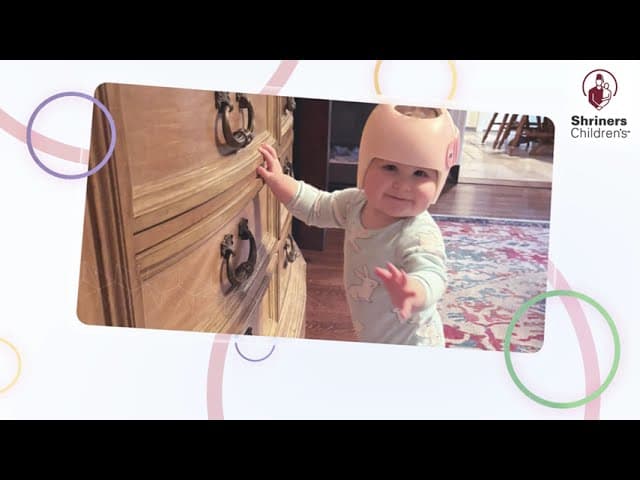
Serafina's Experience with Cranial Remolding

Serafina's Experience with Cranial Remolding

Serafina's mom, Ellen, shares a first-hand account of her family's journey with helmet therapy through Pediatric Orthotic and Prosthetic Services (POPS) at Shriners Children's Erie.
View Transcript

[title card: Serafina's Story]

[Shriners Children's logo]

Speaker:

I was at a regular, well baby checkup and the pediatrician noticed that my daughter was not turning her head properly to one side. The other side was fine and it was suspected at birth because she was frank breach in utero. And so her head was stepped one side. At seven months, they realized that her head really was not turning well the one way. So we got referred to Shriners and got right in for an appointment during which everything was able to happen at one time. So we saw the nurse practitioner, she did measurements, she evaluated, then we immediately got to see the physical therapist and she recommended that we go to POPS to get a um, more thorough evaluation of the shape of the head. The nurse practitioners diagnosed her with both plagiocephaly, the flat head caused by the torticollis, the inability to shift her neck in both directions.

And I had never heard either of those terms for my own children or in general. And I was intimidated by them. And I felt terrible that my child was going through something that we didn't realize, you know, was a diagnosis, let alone one that she had. So I had a lot of questions that they answered so thoroughly and so kindly, and I was so glad that the moment that we heard those diagnoses, there was also a plan set in place the same day. So it wasn't diagnosis, panic, panic, and then wait to get in to see someone to have a plan of action. Everything was able to happen in the one appointment since there, or all the practitioners under one roof.

When the POPS team did the 3D model of my daughter's head, I was shocked 'cause it looks different in person. You know, you're looking at the head that you see every single day, but whenever they show the deficit or the flat spot, it's really shocking. And I was so grateful 'cause they gave a really accurate measurement. When I saw it on the screen. I knew immediately that I would go through with whatever intervention POPS recommended. Um, whereas before I was sort of on the fence if she would need the helmet or not.

My initial reaction, I thought that it would be painful for her and also complicated for us as parents to, um, navigate. But I did not yet understand how it worked. And Hannah, in the pops department explained how it works, how it's not painful for the baby and it allows the baby's head to grow properly rather than molding it like clay. Like it doesn't actually hurt them at all. And then once it was on Seraphina, it was, she had no idea, she didn't even care. They're so young and they're the age where they're just starting to explore their environment. They don't have any clue that there's something very lightweight and very easy to put on on their head. And the care of it was very simple. You just take it off whenever they're about to go into the bath, clean it with rubbing alcohol and let it air dry.

I would tell a parent who's facing a similar situation with their child to ask all the questions to trust Shriners because every question I had, if it did not belong to the department I was asking it of, they would forward that question on to someone else and give it right back to me. So no one ever said, I don't know. No one ever said, that's not my department. They would find the answer for me, give it back, um, or match me with a practitioner that would be able to answer the question.

Oh my goodness. When she graduated from the helmet, I cried. I was so excited. They gave her a certificate with her name and the date of her graduation and everybody was congratulatory. She did so well with the helmet and I'm just so grateful to the professionals that worked with us. But they got us in and out in four months.

[Shriners Children's logo]

Cranial Remolding Wear and Care Instructions

Cranial Remolding Wear and Care Instructions

Your child will start wearing their cranial orthosis 23 hours a day but will need time to adjust to wearing the STARband. This schedule was developed to prevent skin problems, and provides a safe way to acclimate to the STARband.
View Transcript

Speaker 1:
Your baby will eventually wear his or her STARband cranial orthosis, 23 hours a day, but needs several days to adjust to wearing the STARband. Follow the schedule on your screen to gradually increase the wearing time. Do not accelerate this program even if your baby is not having any problems. This wearing schedule was developed to prevent skin problems and to help your baby adjust to the STARband. This wearing schedule provides a safe way to acclimate to the STARband. The fifth day is considered full-time wear, and at this point, the STARband should only be removed for one hour per day. The STARband should be removed and cleaned during the baby's bath. Remove the STARband if your baby has a fever or the flu. Return to full-time wear as soon as possible.

[A bar graph titled “STARband wearing schedule program” with data depicting how long to wear the STARband cranial orthosis that reads “Day: 1 ON 1hr, OFF 1hr” NAP and NIGHT crossed out, “Day: 2 ON 2hr, OFF 1hr” NAP and NIGHT crossed out, “Day: 3 ON 4hrs” OFF 1hr, NAP and NIGHT with a check mark, and “Day: 4 ON 8hrs, OFF 1hr” NAP and NIGHT with a check mark.]

If the baby has not been able to wear the Star band for 48 hours, ramp up the wearing schedule slowly over a few days to help the baby adapt to wearing the STARband again. If your baby has been diagnosed with torticollis, the torticollis must be treated in order to achieve head shape correction. If your therapist or physician has given you neck exercises to perform, remove the STARband for the exercises and replace the band as soon as the exercises are finished at bath time each day, remove and clean the STARband. Only use unscented rubbing alcohol to clean the inside of the STARband. Other cleaners, such as soap, water, bleach or perfume, can cause skin irritation and should not be used inside the STARband.

Vigorously rub the inside of the STARband with a clean wash cloth containing the rubbing alcohol, or apply rubbing alcohol using a new soft toothbrush. Set the band upside down to dry. A fan, in addition to the rubbing alcohol, may be used to help alleviate odor that sometimes develops inside the band. Drying in the sun can also help to alleviate the odor and speed up the drying process. Shampoo the baby's head daily and reapply the STARband when both the head and the band are dry. Babies with very sensitive scalps may benefit from a mild unscented hypoallergenic shampoo. The STARband should not get wet and should be removed for swimming.

After swimming, wash your child's head with shampoo to remove chlorine, sunscreen, et cetera. Reapply the orthosis when both your baby's hair and the STARband are dry. For the first several days, your baby may perspire excessively until his or her body becomes accustomed to the STARband. This is normal. And during this time, the STARband can be removed for a couple of minutes throughout the day to dry the baby's head and band with a towel or cool hairdryer. The STARband should be reapplied as soon as the baby's hair and the band are dry. Do not use powders, lotions or wipes on the baby's head or inside the STARband. These products may contain perfumes and ingredients that can lead to skin irritation. Dress your baby in cooler clothing if the baby perspires excessively.

If the baby develops a rash, consult your doctor immediately. Also, keep the baby as cool as possible, and towel or blow-dry the baby's hair and the inside of the band throughout the day with a cool hairdryer to prevent moisture buildup. Replace the STARband as soon as the band and hair are dry. Time out of the band should be less than 10 minutes. If you need to cut your baby's hair during STARband cranial orthosis treatment, do not shave the entire head. The contact of the band against the head may cause irritation when the hair starts to grow back in, and the baby may develop skin irritation. Try to keep your baby's hair the same length throughout treatment to prevent fitting problems that may result from a decrease or increase in the amount of hair.

Skin checks should be performed every time the STARband is removed. Call your practitioner immediately if there's an area of deep redness that does not fade in one hour after removing the band. This may indicate a need for an adjustment. If there is any skin breakdown, remove the band and contact your doctor. The STARband should not be worn until the skin is healed. Excessive time out of the STARband, more than 48 hours, may create problems with the fit of the STARband since the baby's head is growing continuously. Limit the time out of the STARband and seek assistance when something prevents your baby from tolerating or wearing the band. Each time you place the STARband on the baby's head, check the chafe strap and stop gap foam insert to make sure they are secure.

Loose parts can be a choking hazard and can result in asphyxiation if the parts are swallowed. When the STARband is off your baby's head, keep the STARband away from family pets. Dogs have been known to chew the plastic and foam liner. The STARband must be worn as prescribed, 23 hours a day to constrain further abnormal growth and encourage growth in the correct locations. Even at the end of treatment, the band should be worn 23 hours a day until the physician, practitioner and caregiver agree that treatment is complete. Early discontinuation of treatment against medical advice may result in incomplete correction of the head shape.

Continued use of the STARband against medical advice may restrict skull growth and may impair brain growth and development. Explain the purpose of the STARband to other caregivers and train them in the proper application, removal and wearing schedule. Training is important for family, friends, daycare personnel and any other person taking care of your baby. If you have questions or concerns about your baby's care, contact your practitioner so that any issues can be resolved quickly. Information and resources are available for caregivers on Orthomerica's website at www.starbandkids.com. Shriners Children's and Orthomerica wishes you and your baby a most successful STARband experience.

[End Card: Shriners Children's Pediatric Orthotic and Prosthetic Services logo, Orthomerica logo, ShrinersChildrens.org]

Shriners Children's Erie 2024

Shriners Children's Erie 2024

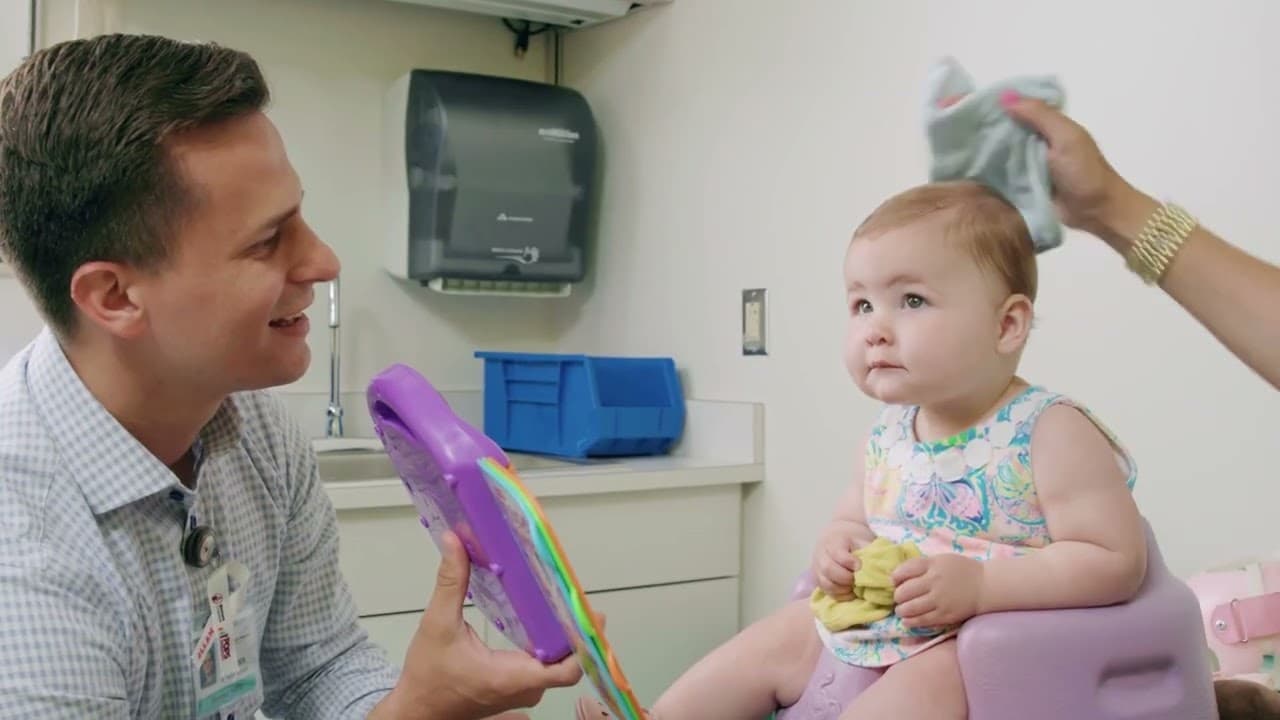
Learn about the family-centered wraparound care offered to every patient at Shriners Children's Erie.
View Transcript

[Shriners Children's logo]

Mary Eighmy, PT, DPT, OCS, Physician Liaison:

At Shriners Children's Erie we have the privilege of offering a variety of services for children age birth to 21. Our services include but are not limited to pediatric orthopedic surgery, physical medicine and rehab, prosthetists and orthotists, physical therapy, occupational therapy.

Christine Betancourt, PA-C, MPAS, Physician Assistant:

I think in the world of orthopedics, you can have a similar injury as a child and as an adult and you can have a completely different injury, so it's important for the patient to have someone that is very well versed and has seen these types of injuries in kids. We know how to manage them appropriately so that we're not undertreating, but we're also not over treating these kids. And I think that's really important.

Alex Betancourt, CPO, Manager, Pediatric and Orthotic Prosthetic Services (POPS):

So POPS is the pediatric orthotics and prosthetic services. It is the orthotic and prosthetic arm of Shriner's Children's. Orthoses are more commonly known as braces, but they are external devices that are used to either correct or support a weakened or deformed limb that a child would need to be functional. Prosthesis is a little bit more, I suppose, well known. It's an artificial limb, arms or legs primarily. And we treat everything from head to toe. We have a great team down in Tampa who serve our staff and our patients extremely well. It's been nice for us to have that in house feel.

Mary Eighmy:

We have the privilege of working with a multidisciplinary team. And so what that multidisciplinary team approach really means is that a child and a family may be able to see multiple practitioners, potentially all in the same day, which cuts back on multiple appointments for that family and also enhances communication between providers.

Alex Betancourt:

The first thing that we work with with the families is what are their goals, and everything is stemmed from that. It really starts with the patient. That's where we also tie in the multidisciplinary team, because if we see that there's something that we think from a rehab side needs to be addressed, we have them right around the corner just to go ask, pull them into a room and get a consult.

Christine Betancourt:

My goal as a provider is to provide the best possible care that I can, and my job is made significantly easier when I'm here and supported by people that have the same vision in mind. And we don't have to think about if the insurance plan is going to cover X, Y, Z. Each patient gets the same treatment no matter their means. I think as a parent that's what I would want for my child, and I'm happy to be able to provide that with the facility here.

[Shriners Children's logo]

3:59
Custom Pediatric Orthotics and Prosthetics Fabrication for Shriners Children's
3:51
Serafina's Experience with Cranial Remolding
6:13
Cranial Remolding Wear and Care Instructions
2:51
Shriners Children's Erie 2024

Map and Directions

Shriners Children's Erie is easily accessible to patients and families. We are located directly off of Interstate 79 and offer free on-site parking.

alt

Shriners Children's Erie is committed to innovative, patient-centered care, ensuring children receive the support they need to thrive.

Our multidisciplinary care model makes it easy for families to coordinate multiple appointments in one visit, allowing children to see several providers efficiently while receiving comprehensive, coordinated care.