


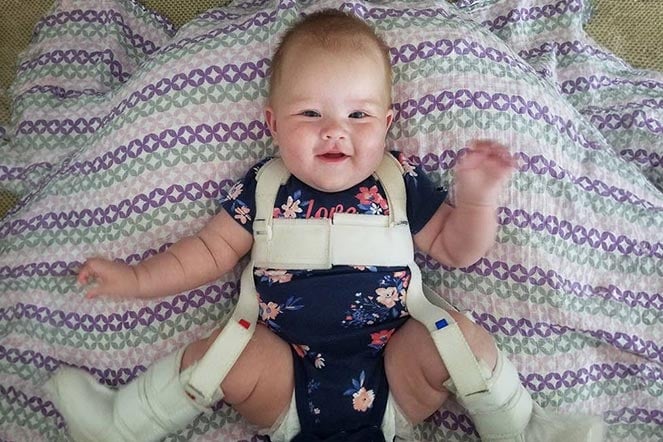
Adaline wears a Pavlik harness during treatment for hip dysplasia.
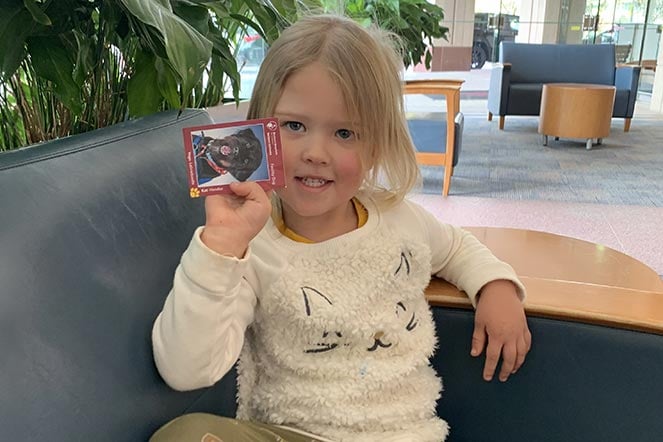
Adaline poses with facility dog Yogo's trading card.
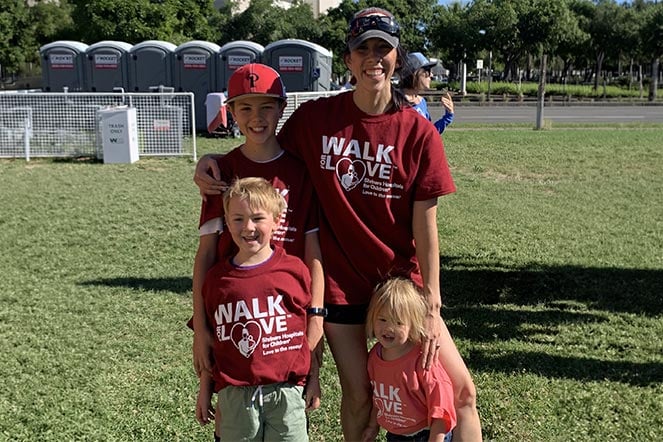
Adaline and her family are pictured together at Walk for Love 2018.
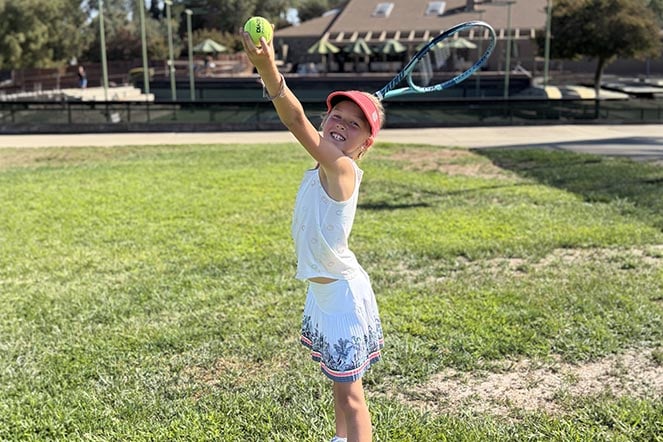
Adaline prepares to hit a tennis ball during a game outdoors.

During a standard newborn examination, her pediatrician noticed something unusual. As he moved her legs, both hips appeared unstable. An ultrasound revealed the cause: bilateral hip dysplasia.
The diagnosis came as a shock to her parents, Lisa and Darin.
As the youngest of four children and their first daughter, Adaline’s early weeks looked very different from what her family had expected.
The family was told they would need to see a pediatric orthopedic surgeon, but the first available appointment was weeks away. While waiting, Lisa did what many parents do when faced with uncertainty: she researched everything she could find. She read about hip dysplasia, joined online support groups and searched for answers about treatment options and outcomes.
“I had every worst-case scenario running through my head,” she said. “I had never heard of hip dysplasia until this point.”
Wanting answers sooner, Lisa called Shriners Children’s Northern California and was able to move Adaline’s appointment up a couple of weeks.
At Shriners Children’s Northern California, Adaline underwent another ultrasound and met orthopedic surgeon Debra Templeton, M.D.
The diagnosis was more serious than her parents had anticipated.
"Adaline had moderate to severe bilateral hip dysplasia," said Dr. Templeton. "Her left hip was more involved, and was unstable on clinical exam. Her initial ultrasound showed a right alpha angle of 52 degrees and only 20% femoral head coverage. The left hip had an alpha angle of 41 degrees and only 5-10% coverage."
A normal alpha angle is 60 or higher and normal coverage is 50% or more, so Adaline needed support, and fast.
Dr. Templeton recommended immediate treatment with a Pavlik harness, a soft brace designed to hold an infant’s hips in the proper position to encourage healthy development. The goal is to influence the natural growth processes of the baby so a more stable hip joint is developed.
For Adaline, that meant wearing the harness 24 hours a day.
As a new mother already navigating the challenges of postpartum life, adjusting to the harness was difficult. Lisa remembers trying to cover it with dresses and leg warmers and relying on sponge baths to keep her baby girl clean.
She also worried constantly about doing everything correctly.
“My daughter had something I couldn’t fix,” she said. “I followed all of Dr. Templeton’s instructions exactly.”
The family rarely went anywhere during those months. Adaline no longer fit easily into typical infant carriers, and Lisa did everything possible to protect her daughter’s hips and ensure the best outcome.
Shriners Children’s changes lives. They are providing the best possible care with the utmost care, compassion and fun.
Fortunately, Adaline responded exceptionally well to treatment.
At every follow-up visit, Lisa received encouragement from Dr. Templeton and the care team. Additional ultrasounds monitored her progress, and clinic visits became opportunities not only for treatment but also for support.
Lisa remembers meeting therapy dogs, chatting with other families in waiting rooms and gaining perspective from seeing children facing much more complex medical challenges.
After just three months in the harness, Adaline’s hips had improved dramatically.
The family continued annual follow-up visits until Adaline was 5, when she was officially cleared.
Today, she has no restrictions and no ongoing treatment needs.
Now 9, Adaline rarely thinks about the diagnosis that once consumed her parents’ thoughts. Instead, she spends her time pursuing the activities she loves.
She is an active and adventurous athlete and participates in gymnastics, tennis and golf. She has also played baseball and soccer and enjoys practicing golf with her father in the field near their home. Recently, she joined a local competitive tennis program and is preparing for her first tournaments.
Outside of sports, Adaline enjoys arts and crafts and was recently accepted into the National Elementary Honor Society.
For her parents, watching their daughter run, compete and explore without limitations is a reminder of how far she has come. The family remains connected to Shriners Children’s Northern California through events such as Walk for Love and continues to support the hospital whenever possible.
“Shriners Children’s changes lives,” Lisa said. “They are providing the best possible care with the utmost care, compassion and fun.”


