paciente joven varón con parálisis cerebral

Shriners Children’s Helps Caleb Drive His Own Success

Caleb relearned to walk multiple times on his path to independence.

You may not know what it means to experience spastic diplegia cerebral palsy (CP).

So let Caleb, 13, explain what it’s like: “It happens in my legs where some of my muscles are very tight, and they need to be loosened,” he said. Describing his legs before treatment, he said they were “kind of bent inwards.”

CP is a brain paralysis or weakness. “His cerebral palsy affects how he walks,” said Kenia, Caleb’s mother. “When his brain tries to tell him that he should do something, his brain tells it, but it doesn't send the message all the way down to his leg.”

“My mind is telling me that my body should be able to do something, but the body’s just not responding,” Caleb said.

The family’s search for medical answers started when he was a toddler. Kenia knew something was not right with her son’s movement, and then he began missing developmental milestones. They came to Shriners Children’s at the suggestion of their family, who found help for scoliosis, another orthopedic issue.

Shriners Children's Chicago is a destination hospital for families where children ages birth to 18 find hope and answers to regular and rare orthopedic conditions affecting a child’s physical development. As part of the Shriners Children’s mission, all care and services are provided regardless of the families’ ability to pay or insurance status. This allows doctors to consider all options for each child.

Caleb’s father, Alex, said the experience at Shriners Children’s was different from day one. Testing and evaluations with physicians who specialize in CP, including a pediatric orthopedic surgeon and pediatric neurologist during the same visit, showed Caleb was an “anomaly.” Dad recalls doctors explaining their son had symptoms consistent with CP but no sign of brain trauma (such as a stroke or abnormality before or during birth) that would cause disability.

“From day one we left with the equipment, and we left with a plan of action, and sort of like a promise that we’re going to figure this out. And it’s been a promise kept ever since,” he said.

Treatment included botulinum toxin injections and physical therapy to help reduce the muscle tightness caused by CP. Over the years, Caleb’s family also navigated daily challenges, including helping him get dressed.

“The struggles with shoelaces, putting on pants because the legs are really tight … him wanting to be independent. But then also being overly careful about him not falling and hitting his head,” Alex said.

Along the way, Caleb’s family, in close partnership with his care team, faced difficult decisions about two major surgeries. One complex procedure, selective dorsal rhizotomy, involved cutting spinal nerves responsible for much of his muscle tightness. Later, Caleb underwent a double osteotomy, during which surgeons cut and realigned both femurs to improve the positioning of his hips, legs and knees. After surgery, the family knew they would return to Shriners Children's Chicago for inpatient rehabilitation, where the medical team and environment had become a special place for them.

“After surgeries, children often need intensive physical therapy because their bodies move very differently than before surgery. The muscle tightness they relied on for movement may be reduced, and their bony alignment has changed, so they must learn how to move with new and more efficient movement patterns,” said Jenna Clancy, PT, DPT, a physical therapist who treated Caleb at Shriners Children’s. “Following this type of surgery, children may feel like they are in a new body, so physical therapy is essential to rebuild strength, balance, coordination, flexibility and endurance.”

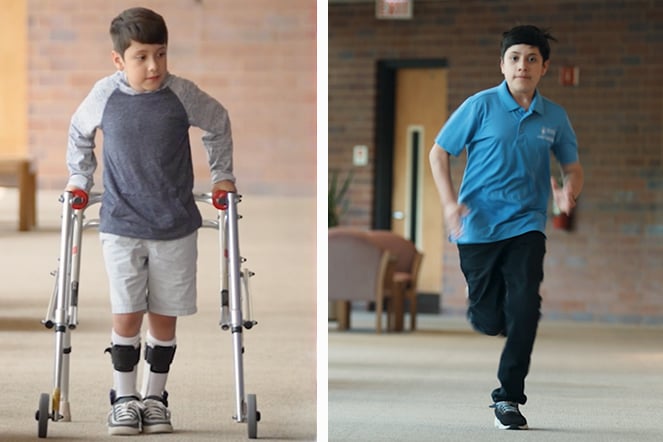
Inpatient therapy helped Caleb relearn to walk. “Physical therapy will typically start with practicing standing and weight shifting. When starting to walk, the patient will gradually transition from more to less restrictive assistive devices. Over the course of several months, Caleb started off walking with use of a reverse walker, progressing to forearm crutches, and eventually he advanced to ambulating [walking] without an assistive device,” said Clancy.

While important work, our therapists make it fun for the patients too. “I used to do a lot of games (in physical therapy) and stuff because I didn’t really want to do any of the things they wanted me to do,” said Caleb. He recalls that a favorite activity was standing on a half-circle balance platform while building Legos. And he loved the always-popular warm-water therapy pool. “I used to do so many fun games in the (hospital) pool.”

Being able to walk again after the surgeries. It’s a major milestone that all my physical therapists help me with.
Caleb, Shriners Children's Chicago patient

Advanced Care

No cure exists for CP, but treatment can improve movement and body control. Shriners Children’s Chicago features a high-tech lab, one of the only accredited motion analysis centers in Illinois or Indiana, that precisely measures a child's movement and helps improve surgical timing.

“I thought I was a robot,” Caleb said when recalling a visit to the Shriners Children's Chicago motion analysis center when he was 8. During the evaluation, sticky marker dots placed on his legs and torso are tracked by motion-capture cameras as he walked. Force plates measure his feet. The data helps his surgeon and physical therapist plan his care. When he was 2, video showed him walking on his toes, legs turned inward all the time.

“What motivates me is looking back at how I was years ago when I first came to Shriners, watching the gait videos of me walking back and forth. Seeing how, I don’t want to say ‘badly’, but how unnormal I was walking. Seeing how far I’ve come. That motivates me to do even better.”

Caleb’s motivation helped him keep going in therapy.

“One of the biggest challenges is that recovery can be a long process. Children often experience weakness, fatigue, soreness and frustration as they heal and adjust to moving in a new way. Progress may happen gradually, requiring daily practice. When children commit to physical therapy, many become more efficient walkers, require less energy for daily activities, experience fewer falls, and have an easier time participating in their daily activities,” Clancy said.

By the time he was 8, Caleb could walk a mile. “To see his gait being straight and his heels going down, it’s just incredible to see the amount of progress that he’s made over the years,” Alex said.

Exceeding His Goals

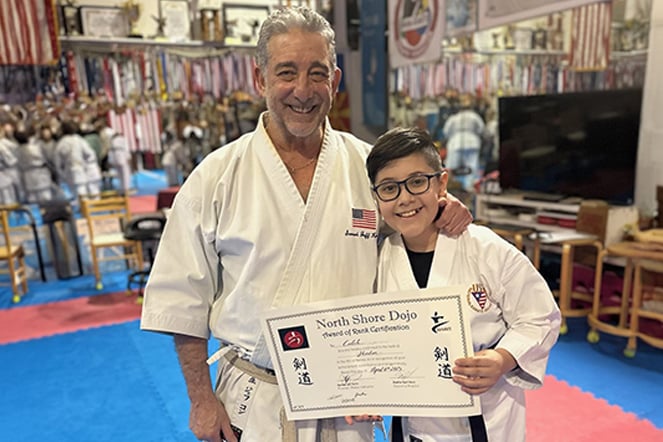
2026 has been a big year for Caleb. He has a black belt in adaptive karate and said he was "proud" to run a mile. “I also ran a mile for school. I did like a 12-minute mile. To be able to achieve, be able to know that you’ve ran it, it’s like really cool.” He also learned to ride a bicycle, which was not possible before treatment.

“A moment that will forever stick in my mind is seeing his excitement last summer when he learned to ride a bike for the first time. Because of CP, there was anxiety around it: will he be safe?” Dad said the bike has given the young teenager a whole new sense of freedom. “His radius was limited to the block that we lived in; now there’s so much more he can explore with his friends on other blocks.”

Caleb’s goals for the future, outside of becoming a famous actor or director, include working on strength and running two miles.

The entire experience is inspiring for his therapist.

“Seeing Caleb return to the activities he loves is exactly why we do what we do. Being able to watch a child gain independence, move more confidently, and participate in everyday life is incredibly rewarding. Being a black belt and running a mile exceeds our goals for physical therapy, but it shows how hard-working Caleb truly is,” said Clancy.

The family encourages others to support Shriners Children’s.

“The doctors know what they are doing. They know what’s best,” said Caleb.

“You are donating to an organization that puts patients and families first. The staff at every level support his care,” said Alex. “We have been able to focus on Caleb’s care and not on how to afford his care … the donors being able to provide financial support so that the parents can focus on the kid. It’s very powerful to have been part of that legacy and also to have benefited from that legacy.”

Driven to Succeed

From relearning how to walk after complex surgeries to running a mile and riding a bike, Caleb’s story is filled with milestones that showcase his determination, resilience and remarkable progress.

During pediatric rehabilitation, Caleb relearns to walk using a walker before progressing to arm crutches and eventually running.

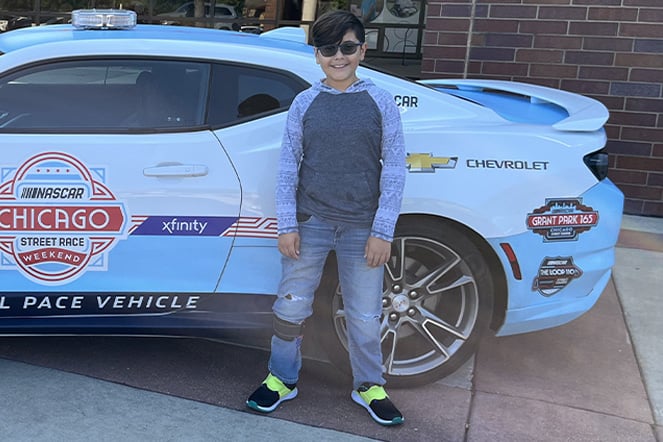
Caleb joins other patients to view a NASCAR pace car parked at the pediatric specialty hospital. The NASCAR experience was a fun moment of lightness and distraction for a boy who has overcome many challenges.

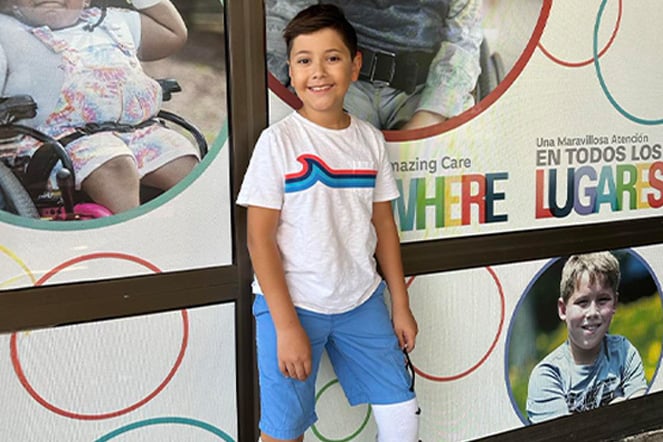
Caleb poses with his photo at the Shriners Children's Chicago entrance.

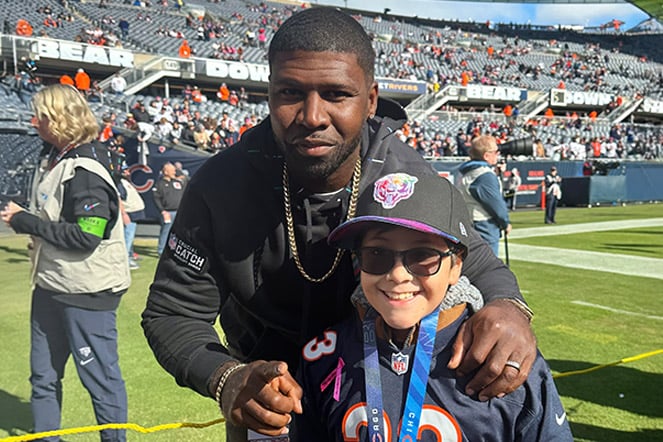
Caleb represents Shriners Children's Chicago patients as a Champion of the Game at a Chicago Bears home game.

Caleb enjoys a variety of activities, including karate, and has earned a black belt.

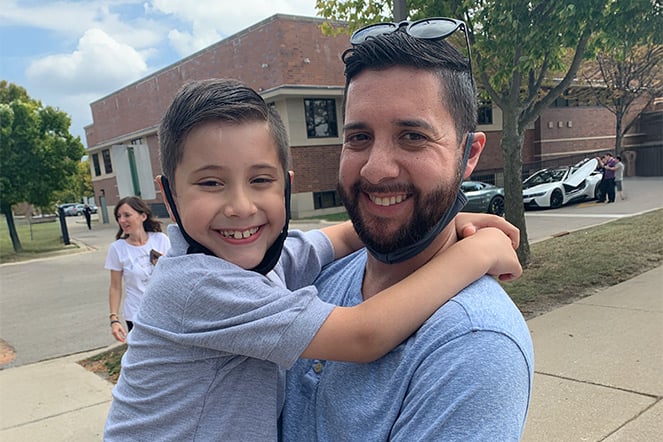
Caleb and his dad, Alex, attend a hospital event.

Excellence in Care

1 in 345

Children in the United States identified with cerebral palsy each year

6

Locations ranked best for orthopedics by U.S. News & World Report

Niña con perro pequeñoinfografía pequeña

Next Steps

Comparte tu historia

icono de mensaje vacío
En Shriners Children's, nuestros pacientes y sus familias son el centro de todo lo que hacemos. Le invitamos a compartir cómo el equipo de Shriners Children's ha ayudado a su hijo/a.

Dona a Shriners Children's

icono de corazón
Gracias a la generosidad de donantes como usted, hemos ayudado a más de un millón de niños a tener una vida más plena, independientemente de la capacidad de pago de sus familias.

Contáctanos

icono de carta
¿Tienes alguna pregunta o solicitud? ¿Necesitas concertar una cita? Estamos aquí para ayudarte.