


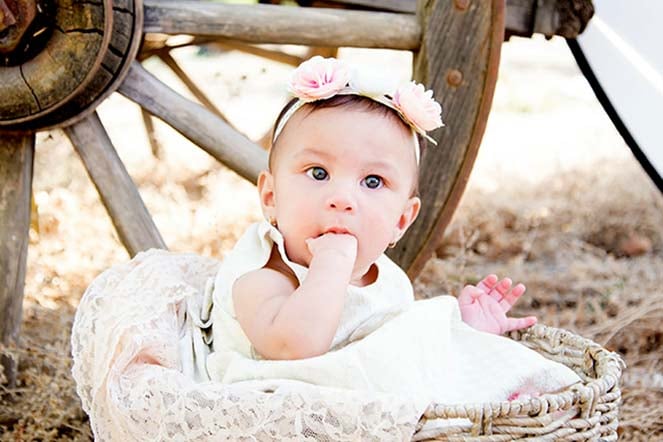
Baby Olivia enjoys the sunshine.
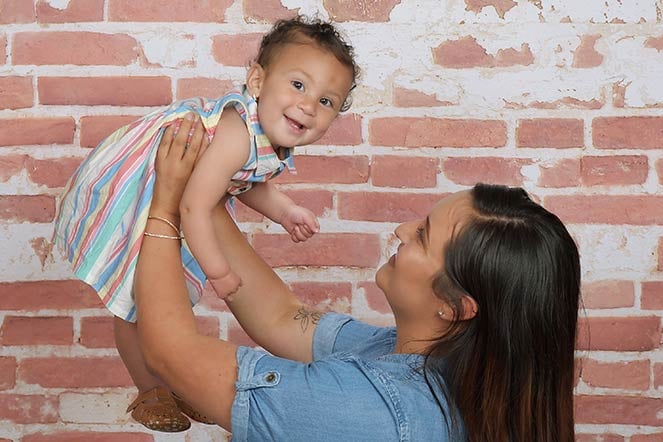
Paulette and baby Olivia share a happy moment together.
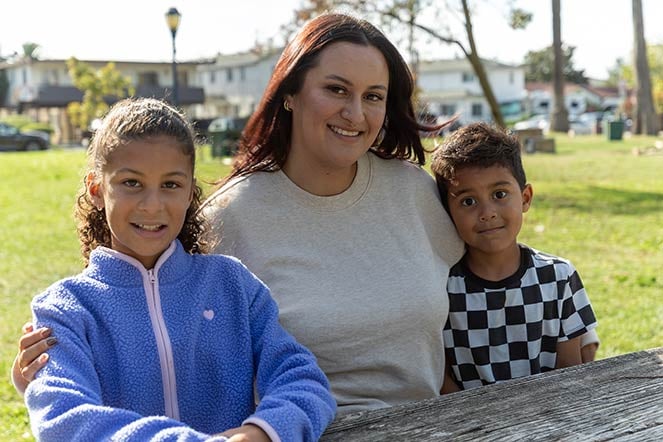
Olivia beams alongside her mom and brother.
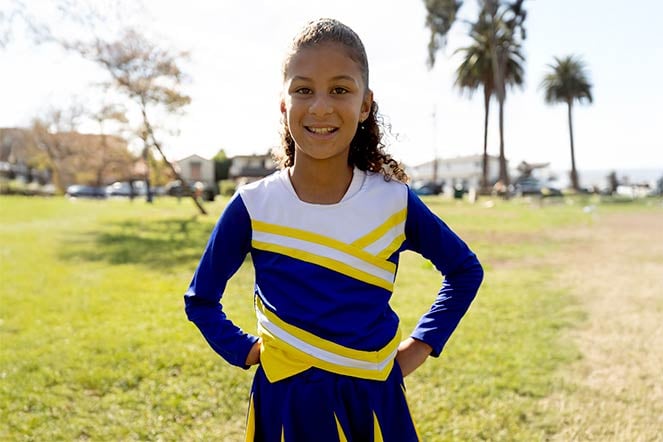
Olivia shines in her cheer uniform.

In Paulette’s ultrasounds, it appeared that her baby had her hand balled up in a fist, so doctors could not tell whether it was developing properly.
Olivia was born with symbrachydactyly, a congenital hand disorder where fingers are abnormally short and webbed or conjoined. She was also born with Poland syndrome, a rare chest wall deformity.
For Paulette, it was initially a scary and uncertain time for their family. “Obviously, you love your child no matter what,” she said. “But it was a little difficult as a parent to think, ‘Oh my gosh, what is she going to go through? How do you explain things to people?’”
Olivia was referred by her primary care physician to Shriners Children’s Northern California’s hand and upper extremity program. During her first checkup, Olivia and her family were comforted by the staff’s knowledge of her condition and reassured that Olivia could lead a full, healthy life. She was initially seen by Claire Manske, M.D., benefitting from her extensive expertise with upper-extremity deformities.
The hand and upper extremity program includes some of the nation’s most sought-after pediatric hand surgeons, who specialize in congenital and acquired hand conditions like Olivia’s. The team includes surgeons and clinical researchers who have published widely in peer-reviewed journals on congenital hand malformations and neuromuscular conditions such as brachial plexus birth injury and post-traumatic hand deformities.
For Olivia, this has meant a non-surgical path focused on adaptability and function. She now only comes in for a yearly checkup, a testament to the stable and effective management of her condition.
“Luckily she hasn’t needed [surgery],” said Paulette. “She’s been good with pinching things together and using her hand as a helper hand.”
A key part of Olivia’s personalized plan has involved the Shriners Children’s Pediatric Orthotic and Prosthetic Services department. These craftspeople are specially trained to work with children and collaborate with physicians to provide customized, personalized devices.
Olivia uses two specialized prosthetics as needed: a flexible helper hand to grip her bike handles and a heavier-duty hook for activities like gymnastics. These tools assist her in specific activities, but Olivia has largely found her own way to do everything; she wears them only when she needs to.
“She’s figured out how to do everything her own way,” said Paulette. “Most activities don’t require her to use both hands to grip.”
She’s figured out how to do everything her own way.
From the beginning, Shriners Children’s Northern California provided more than just clinical care. The family found immense value in being able to see other patients with hand differences. It gave them a chance to see others functioning and made them realize they weren't alone.
This foundation of support has allowed Olivia to flourish. She is now completely comfortable with her differences and has a strong group of friends at school. She shares about her hand only when she feels comfortable, a sign of her growing self-assurance.
Olivia’s spirit shines through her many hobbies.
She is artistically inclined, with a passion for drawing and photography. Her athletic pursuits are diverse and dynamic. She has done gymnastics and swimming, is starting cheerleading, and this past August she began Mexican folklorico dancing. Each activity is a celebration of what her body can do, with or without adaptive devices.
The goal for treatment at Shriners Children's is to give a child a limb that works and looks right, but also to encourage self-care and independence. For Olivia, this mission has been accomplished.


