


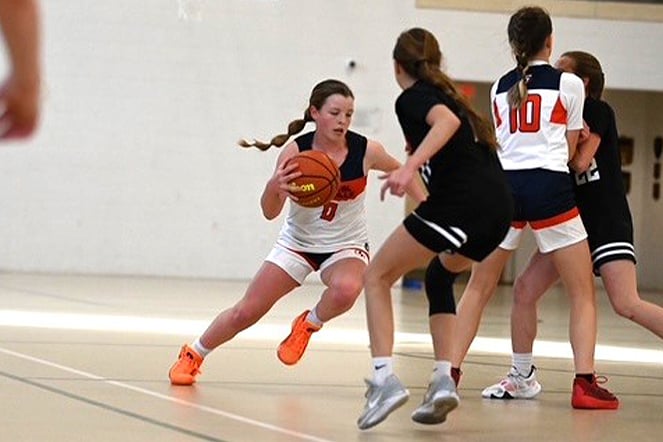
Gracie plays basketball before her ACL tear.
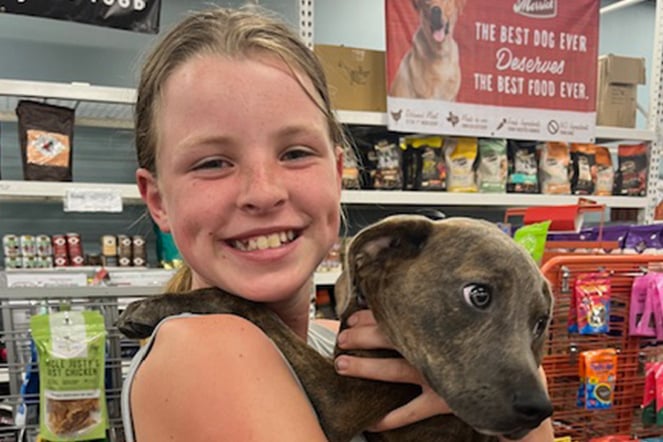
Gracie holds a dog in the pet store.
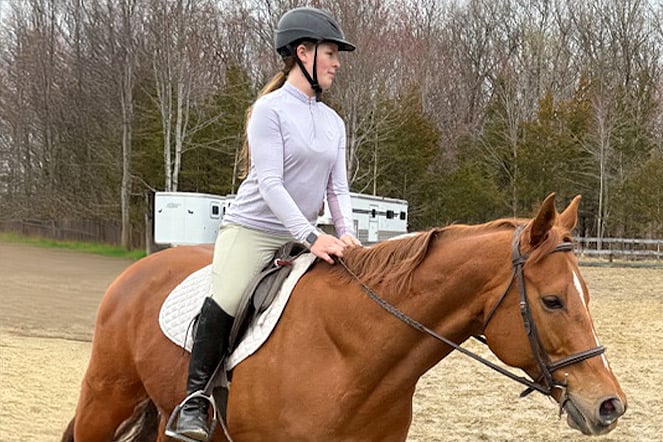
Gracie rides a horse.
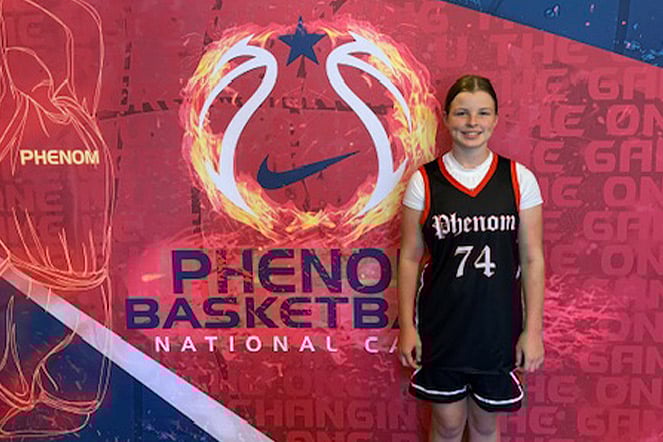
Gracie stands in her basketball uniform in front of a sign at basketball camp.

She played frequently, until an anterior cruciate ligament (ACL) tear on her right leg put her play on hold, something no young athlete wants to experience.
An ACL tear is a common knee injury treated in our sports medicine clinics. One day, when Gracie was playing basketball, an opponent pushed her to the side, causing her knee to pop when she landed on her right leg. This pop was ultimately an ACL tear, and Gracie sat out of the rest of the game and iced her knee. When her parents took her to urgent care the next day, she was misdiagnosed. The urgent care physician said she had a hyperextension, not a tear. As Gracie was not in excruciating pain and her diagnosis at the time was not severe, she played two more games of basketball the next week. Although she didn’t know until after these games, she had exacerbated the injury.
Gracie and her family contacted her pediatrician, who then referred Gracie to Shriners Children’s. As Shriners Children’s Doylestown, one of our system’s outpatient clinics, is only 10 minutes away from Gracie’s home, it was a convenient option for her family. When Gracie attended her appointment at the Doylestown clinic she brought her original X-ray from her urgent care visit. After examining that X-ray, Sean Waldron, M.D., ordered an MRI for further imaging to give a more detailed evaluation of the injury.
After seeing the MRI results, Dr. Waldron diagnosed the injury as an ACL tear, and it was determined Gracie would need surgery to ease her pain and discomfort, as well as safely return to sports. Dr. Waldron determined that Gracie was a good candidate for the BEAR® Implant, which stands for Bridge Enhanced ACL Repair. This innovative procedure uses an implant injected with the patient’s own blood to heal and mend the two torn ends of the ACL. The procedure is less invasive than other ACL reconstructive surgeries. Gracie and her family chose this option for surgery.
Dr. Waldron said, “The BEAR implant is an incredible option for children who sustain ACL tears like Gracie’s. Not every tear is amenable to this technique, but thankfully there was enough ligament to allow for a successful repair. Adding the BEAR implant protects the repair during the early healing process and gives us the stability necessary for an outstanding outcome. The rest is up to Gracie, who clearly has the drive and determination to work hard during the rehab phase so that she can set herself up for returning to sports at a high level.”
The office staff in Doylestown and the nurses in the hospital are awesome.
Gracie had this surgery at Shriners Children’s Philadelphia, performed by Dr. Waldron, and it was successful. She sees Dr. Waldron for follow-up appointments at Shriners Children’s Doylestown to ensure she is healing properly. Gracie is currently resting her leg and waiting to return to sports until she is fully recovered. She is wearing a brace on her right leg to stabilize her knee as she heals. Amanda, Gracie’s mother, said of Dr. Waldron, “He was great! He explained everything step by step, and he talks to Gracie directly, which is helpful.”
Amanda also said of their quality of care, “The overall process has been great, super simple, not stressful. Everyone is very supportive and helpful in every way, which makes it easier for us to get through this. The office staff in Doylestown and the nurses in the hospital are awesome. Everyone has been great!”
In addition to playing basketball, Gracie enjoys playing soccer and riding horses. She wants to be an exotic large animal vet when she is older. She went to the Philadelphia Zoo often as a young child, which inspired her love of animals and caring for them. Gracie has two cats, two hermit crabs, a rabbit and several fish. She also enjoys crafting, and made miniature hobbyhorse pens as gifts of thanks for all her inpatient nurses at Shriners Children’s Philadelphia. Gracie’s uplifting personality and enthusiasm for life brightens the days of everyone she interacts with. We look forward to seeing her return to all her favorite activities on a healed leg in the near future.


